
Bahrain Leaving Indemnity Calculation (2026): The Formula, the SIO System and Who Pays
Your Bahrain leaving indemnity calculation now has two halves, and most people only know about one of them.
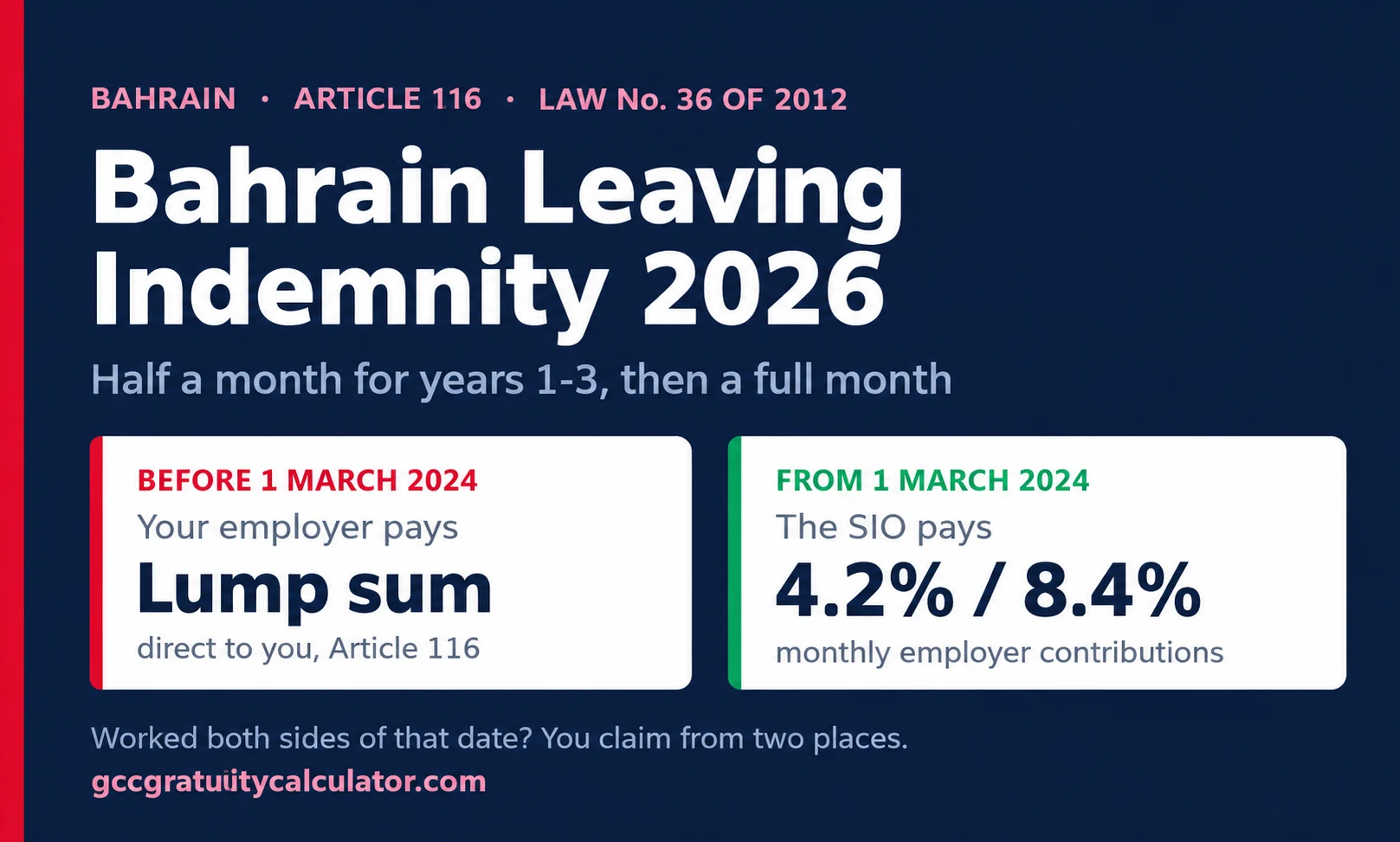
Service up to 1 March 2024 is still your employer’s liability, paid directly to you as a lump sum. Service from that date onwards is funded by monthly employer contributions to the Social Insurance Organisation, and the SIO pays that part — not your employer.
If you joined before March 2024 and leave after it, you claim from two places. An employee who chases only their employer collects part of the money and leaves the rest sitting with the SIO.
This guide sets out the Article 116 formula, which salary it runs on, your figure on every common wage, how the new system changed who pays, and what resignation does to it — which in Bahrain, unlike Kuwait, is nothing at all.
Quick Answer
| Question | Answer |
|---|---|
| First 3 years | Half a month’s wage for each year |
| Year 4 onwards | One month’s wage for each year |
| Which salary? | Last basic wage plus social allowance |
| Part years | Paid in proportion, counted in days |
| Under one year? | Still paid, pro rata |
| Does resigning reduce it? | No |
| Is there a cap? | No, for expatriate employees |
| Who pays? | Employer for service before 1 March 2024, SIO for service after |
| Governing law | Articles 47, 107 and 116, Law No. 36 of 2012 · Edict 109 of 2023 |
Everything below builds on those nine lines. If you only have a minute, the two that move money most are the salary used and the 1 March 2024 split.
The Bahrain End of Service Formula
Article 116 of Labour Law No. 36 of 2012 sets a two-band scale:
| Service | Rate per year |
|---|---|
| Each of years 1 to 3 | Half a month’s wage (15 days) |
| Each year from year 4 | One month’s wage |
The Bahrain indemnity half month first 3 years rule gives you 1.5 months of wage for your first three years, and a full month for every year after that.
A shortcut worth remembering: for any service beyond three years, your indemnity in months equals your years of service minus 1.5. Ten years is 8.5 months of wage. Twenty years is 18.5.
How to calculate leaving indemnity Bahrain employees are owed
Three steps.
Step 1 — Establish the wage. Take your last basic wage and add your social allowance, if you receive one. Nothing else.
Step 2 — Apply the two bands. Half a month for each of years one to three, one month for each year after.
Step 3 — Pro rate the part year. Fractions are paid in proportion, counted in days against a 365-day year.
On a BHD 400 wage with seven years of service:
Years 1-3:  3 × 0.5 × BHD 400  =  BHD 600
Years 4-7:  4 × 1.0 × BHD 400  =  BHD 1,600
Total                           =  BHD 2,200
That is the whole of a Bahrain leaving indemnity calculation. There is no length-of-service multiplier beyond year four, no cap, and no reduction for how the employment ended.
Run your own dates in the Bahrain Gratuity Calculator, which applies both bands, the social allowance and the part-year proportion automatically.
Bahrain Leaving Indemnity by Years of Service
All figures on the combined basic wage plus social allowance.
| Service | BHD 300 | BHD 400 | BHD 500 | BHD 600 |
|---|---|---|---|---|
| 1 year | BHD 150 | BHD 200 | BHD 250 | BHD 300 |
| 2 years | BHD 300 | BHD 400 | BHD 500 | BHD 600 |
| 3 years | BHD 450 | BHD 600 | BHD 750 | BHD 900 |
| 4 years | BHD 750 | BHD 1,000 | BHD 1,250 | BHD 1,500 |
| 5 years | BHD 1,050 | BHD 1,400 | BHD 1,750 | BHD 2,100 |
| 7 years | BHD 1,650 | BHD 2,200 | BHD 2,750 | BHD 3,300 |
| 10 years | BHD 2,550 | BHD 3,400 | BHD 4,250 | BHD 5,100 |
| 15 years | BHD 4,050 | BHD 5,400 | BHD 6,750 | BHD 8,100 |
| 20 years | BHD 5,550 | BHD 7,400 | BHD 9,250 | BHD 11,100 |
Every row in that table is a straight Bahrain leaving indemnity calculation — two bands, one wage figure, nothing else.
Year four is where the pace doubles. On BHD 400, year three adds BHD 200 and year four adds BHD 400.
Bahrain reaches its higher rate faster than most of the Gulf. Kuwait does not reach its one-month band until year six, and caps the whole thing at 18 months’ wage. Bahrain has no ceiling at all for expatriate employees — however long you stay, the figure keeps climbing.
Bahrain Gratuity BD 300 and BD 500: The Working
The table gives the totals. Here is the calculation itself for the two most common wage bands, so you can check a figure by hand.
Bahrain gratuity BD 300
Half a month: BHD 150 Full month: BHD 300
| Service | Calculation | Indemnity |
|---|---|---|
| 2 years | 2 × 150 | BHD 300 |
| 3 years | 3 × 150 | BHD 450 |
| 5 years | 450 + (2 × 300) | BHD 1,050 |
| 10 years | 450 + (7 × 300) | BHD 2,550 |
A BD 300 leaving indemnity Bahrain employers once paid as a lump sum is now funded by the SIO at BHD 12.60 a month during your first three years, rising to BHD 25.20 a month from year four. If you want to know what your Bahrain end of service BD 300 entitlement is building up to, that is the figure quietly accruing in the background each month.
Bahrain gratuity BD 500
Half a month: BHD 250 Full month: BHD 500
| Service | Calculation | Indemnity |
|---|---|---|
| 2 years | 2 × 250 | BHD 500 |
| 3 years | 3 × 250 | BHD 750 |
| 5 years | 750 + (2 × 500) | BHD 1,750 |
| 10 years | 750 + (7 × 500) | BHD 4,250 |
A BD 500 leaving indemnity Bahrain employers fund at BHD 21.00 a month for the first three years and BHD 42.00 a month afterwards. A Bahrain end of service BD 500 salary therefore accrues just over half a thousand dinars every two years once you are past year three.
Working in a different Gulf country? Our GCC gratuity calculators cover all six, and the rules differ more than most people expect.
What Salary Is Used for Bahrain Gratuity?
This is where figures most often go wrong, and where Bahrain differs from almost every one of its neighbours.
Article 47 bases the calculation on your last basic wage plus social allowance, where one is paid. Every other allowance is excluded.
Included: basic wage, social allowance Excluded: housing allowance, transport allowance, overtime, commission, performance bonuses, mobile and fuel allowances
Does social allowance count for gratuity Bahrain employees receive?
Yes — and this is the single most valuable line on this page.
Social allowance is not an optional extra in the calculation. It forms part of the wage base alongside basic pay, which means a Bahrain gratuity basic plus social allowance figure is higher than one worked out on basic alone, and it is the correct one.
On a package of BHD 400 basic plus BHD 100 social allowance plus BHD 150 housing:
| Basis used | Wage | 10 years |
|---|---|---|
| Basic only | BHD 400 | BHD 3,400 |
| Basic + social allowance | BHD 500 | BHD 4,250 |
| Whole package | BHD 650 | BHD 5,525 |
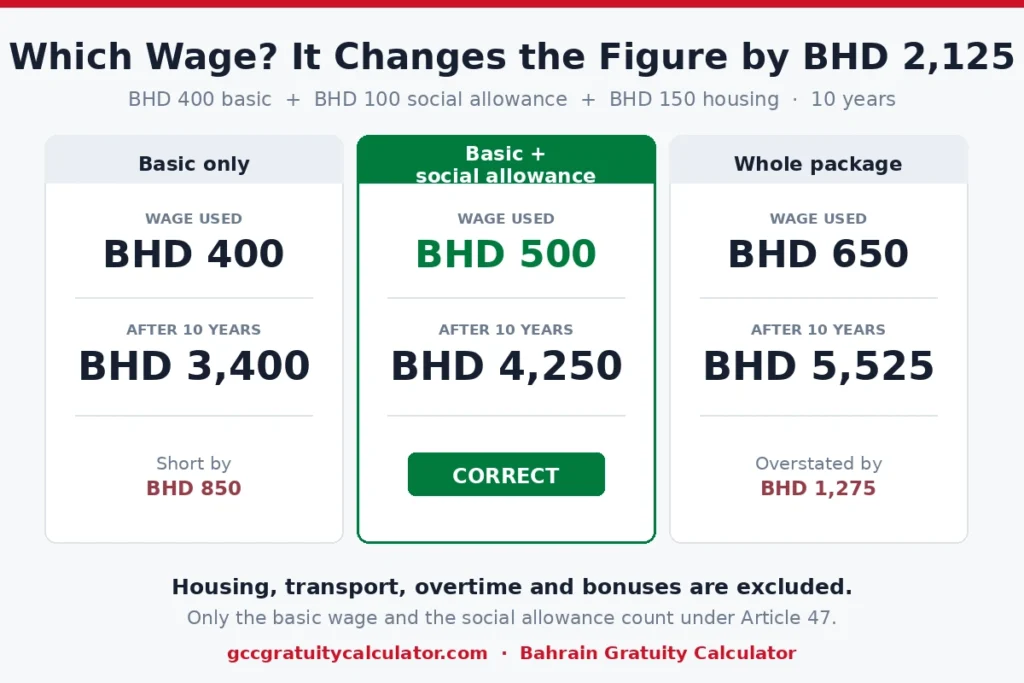
The correct figure is the middle row — BHD 4,250. Get this one input wrong and every other step of your Bahrain leaving indemnity calculation is wrong with it. An employer who calculated on basic alone has short-changed you by BHD 850. One who used the whole package has overstated it by BHD 1,275, and that figure will not survive a challenge.
Check your payslip for a line called social allowance. Many Bahraini contracts carry one and many calculations quietly leave it out.
Qatar takes the stricter approach — basic salary only, no allowance of any kind counts, and no argument is available. Bahrain is one of the few places in the Gulf where an allowance genuinely belongs in the base.
You Still Get Paid Under One Year
This catches people out, because it is the opposite of the rule almost everywhere else in the Gulf.
In the UAE, Qatar, Kuwait and Oman, twelve months of continuous service is the gate. Below it, most employees receive nothing at all.
Bahrain has no such gate. Article 116 pays a fraction of a year in proportion to the period served, and that applies from your first month.
| Service | BHD 400 wage |
|---|---|
| 3 months | BHD 50 |
| 6 months | BHD 100 |
| 9 months | BHD 150 |
| 11 months | BHD 183 |
Not large sums, but they are owed. A short-service employee told “you did not complete a year, so nothing is due” is being given the rule from a different country.
How part years are counted
In days, against a 365-day year.
An employee on a BHD 380 wage who completes 101 days into their fifth year earns, for that fragment:
101 ÷ 365 × BHD 380 = BHD 105.15
Year five sits in the one-month band, so the fraction is applied to a full month’s wage. Had the same 101 days fallen inside year two, it would be applied to half a month instead.
Bahrain SIO End of Service: The New System Explained
Under Edict 109 of 2023, Bahrain moved end-of-service provision for expatriate employees from a lump sum paid at the end to monthly contributions paid as you go, from 1 March 2024.
Who pays gratuity in Bahrain now?
Both, depending on when you earned it.
| Service period | Paid by | How |
|---|---|---|
| Up to 1 March 2024 | Your employer | Lump sum, direct to you, on the Article 116 formula |
| From 1 March 2024 | The SIO | From accumulated contributions, claimed on leaving |
If your whole employment started after March 2024, the answer is simple: the SIO pays all of it. If you were already employed before that date, your employer still owes you the earlier portion directly, and that liability did not transfer anywhere.
SIO gratuity payment Bahrain rates
Your employer pays the Social Insurance Organisation every month, within the first fifteen days:
| Service year | Monthly contribution |
|---|---|
| Each of years 1 to 3 | 4.2% of monthly salary |
| Year 4 onwards | 8.4% of monthly salary |
Employees who already had more than three years of service on 1 March 2024 were placed on the 8.4% rate automatically.
Late payment attracts 5% interest. Non-payment adds a 20% penalty. Those penalties exist because the contribution is a legal obligation on the employer, not a discretionary benefit.
Bahrain end of service insurance for expats: is it worse?
No — and the arithmetic settles it.
Half a month’s wage per year is 1 ÷ 24 = 4.167% of monthly salary each month. One month’s wage per year is 1 ÷ 12 = 8.33%.
The SIO rates are 4.2% and 8.4% — the same two Article 116 bands, rounded very slightly upward. The Bahrain gratuity new system is not a cut. It is the existing entitlement, funded monthly instead of promised at the end.
What genuinely changed is who holds the money. Under the old arrangement your indemnity was an unfunded promise sitting on your employer’s balance sheet, and an employer in difficulty was an employer you might have to chase through the courts. Under the SIO system the money has already left them before you ever resign.
For most expatriate employees, that is a straightforward improvement.
One thing worth checking
The SIO requires employers to report salary data covering all remuneration — basic pay, allowances such as housing and car, commissions and annual bonuses. The statutory Article 116 entitlement, meanwhile, runs on basic plus social allowance only.
Those two bases are described differently, and what any individual actually receives depends on the salary figure their employer registered.
Ask your employer which salary they reported to the SIO. If it is materially lower than what you are paid, raise it while you are still employed. After you leave, you are arguing about a contribution history you can no longer influence.
Worked example: claiming from both
An employee joined 1 March 2019 on a BHD 500 wage and leaves 1 March 2026 — seven years in total.
| Period | Who pays | Amount |
|---|---|---|
| Mar 2019 – Mar 2024 (5 years) | Employer | 3.5 × BHD 500 = BHD 1,750 |
| Mar 2024 – Mar 2026 (2 years) | SIO | 8.4% × BHD 500 × 24 months = BHD 1,008 |
| Total | BHD 2,758 |
Compare that against seven years calculated in one block under Article 116: 5.5 × BHD 500 = BHD 2,750. Almost identical, as it should be, since the contribution rates mirror the formula.
The lesson is that a Bahrain leaving indemnity calculation spanning March 2024 is not one sum but two, added together.
The risk is not the amount. It is forgetting the second claim. Pursue only your employer and you collect BHD 1,750, leaving BHD 1,008 with the SIO.
Bahrain Gratuity on Resignation
Do I get indemnity if I resign in Bahrain? Yes, in full.
This is one of the cleaner rules in the Gulf. Bahrain applies the same formula however the employment ends — there is no reduction scale, no qualifying period for resignation specifically, and no percentage to argue about.
| How employment ends | Indemnity |
|---|---|
| Resignation | Full entitlement |
| Termination by employer | Full entitlement |
| Contract expiry | Full entitlement |
| Redundancy | Full entitlement |
| Retirement | Full entitlement |
| Dismissal under Article 107 | May be forfeited |
A Bahrain resignation end of service figure is therefore identical to a termination figure on the same wage and the same service. Your Bahrain leaving indemnity calculation does not change at all because you were the one who handed in notice. If your employer has quoted you a reduced amount because you resigned, ask which article they are relying on.
Kuwait is the opposite case — resigning there with under three years of service pays nothing at all, and the full amount only arrives at ten years. Employees who have worked in both countries often assume Bahrain works the same way. It does not.
Article 107 covers defined serious misconduct, and is the only route by which the indemnity can be withheld. Outside those grounds it is a statutory right — not discretionary, and not available as leverage during your exit.
Where a dismissal is found to be unjustified, compensation for that is awarded in addition to the indemnity. It does not raise the indemnity rate itself.
Bahraini Nationals Are Treated Differently
Everything above describes the position for expatriate employees, who are the group the SIO scheme was built for.
Bahraini nationals are covered by social insurance for their pension provision. Where a Bahraini employee earns above BHD 4,000 a month, indemnity is calculated on the portion of the wage above that threshold.
If you are a Bahraini national, check your SIO record rather than relying on an indemnity calculation alone.
Common Mistakes
Leaving out the social allowance. The single most expensive error in a Bahrain leaving indemnity calculation, and the easiest to check — look at your payslip.
Including housing and transport. The opposite error. Only basic and social allowance count.
Assuming nothing is due under one year. Bahrain pays pro rata from your first month. That rule belongs to the UAE and Qatar, not here.
Chasing only your employer. Service after 1 March 2024 is claimed from the SIO.
Counting from the latest contract renewal. Renewals are continuous service. Three two-year contracts is six years, not two — and the difference straddles the band change at year four.
Thinking the SIO system reduced your entitlement. 4.2% and 8.4% are the Article 116 bands expressed monthly.
Assuming resignation cuts it. It does not in Bahrain.
If Your Indemnity Is Not Paid
Work out your own figure first, split across the two periods, so you know which part you are chasing and from whom.
Request it in writing. Ask your employer for an itemised statement showing the wage used, your service dates, how the pre- and post-March-2024 periods were split, and any deduction.
Check the SIO side separately. If contributions were not paid for your post-March-2024 service, that is a compliance failure by your employer with its own penalty regime attached — 5% interest on late payment and a 20% penalty for non-payment.
Gather your documents. Employment contract and renewals, CPR, payslips showing basic wage and social allowance, bank statements, and your resignation or termination letter.
Then escalate to the Ministry of Labour, and onward to the labour courts if it is not resolved there.
Do not leave Bahrain with this unresolved. Pursuing a settlement from abroad is considerably harder than resolving it while you are still in the country, and a release signed before payment lands removes almost all of your position.
Work Out Your Own Figure First
Enter your basic wage, your social allowance and your service dates in the Bahrain Gratuity Calculator.
If your service started before 1 March 2024, note which part of the total belongs to each period — that tells you how much to expect from your employer and how much to claim from the SIO.
Doing your own Bahrain leaving indemnity calculation first is what turns a vague disagreement into a specific one.
Establish the number before the conversation starts. The difference is a much shorter discussion than the whole calculation.
Frequently Asked Questions
How do I do a Bahrain leaving indemnity calculation?
Half a month’s wage for each of your first three years, then one month’s wage for each year after, calculated on your last basic wage plus social allowance. Part years are paid in proportion.
Can I do a Bahrain leaving indemnity calculation myself?
Yes. Add your basic wage and social allowance, take half a month for each of years one to three and a full month for each year after, then pro rate the part year in days. The only hard part is splitting service across 1 March 2024.
What is the Bahrain end of service formula?
For service beyond three years, your indemnity in months equals your years of service minus 1.5. Ten years is 8.5 months of wage.
Is it really half a month for the first 3 years?
Yes. The Bahrain indemnity half month first 3 years rule comes from Article 116, which pays 15 days’ wage for each of years one, two and three, and a full month for each year from year four.
What salary is used for Bahrain gratuity?
Your last basic wage plus social allowance, where one is paid. Housing, transport, overtime, commission and bonuses are excluded.
Does social allowance count for gratuity Bahrain workers receive?
Yes. Social allowance forms part of the wage base under Article 47. A Bahrain gratuity basic plus social allowance calculation is the correct one, and it is higher than a basic-only figure.
What is the Bahrain gratuity for a BD 300 salary?
BHD 450 after three years, BHD 1,050 after five and BHD 2,550 after ten.
What is the Bahrain end of service for a BD 500 salary?
BHD 750 after three years, BHD 1,750 after five and BHD 4,250 after ten.
Who pays gratuity in Bahrain now?
Your employer for service up to 1 March 2024, and the SIO for service from that date. If you worked on both sides of it, you claim from both.
What is Bahrain SIO end of service?
It is the system introduced by Edict 109 of 2023, under which employers fund expatriate end-of-service benefits through monthly contributions to the Social Insurance Organisation rather than paying a lump sum when the employee leaves.
What are the SIO gratuity payment Bahrain rates?
4.2% of monthly salary for each of the first three years of service, and 8.4% from year four. Employees with more than three years of service on 1 March 2024 were moved to 8.4% automatically.
Did the Bahrain gratuity new system reduce my entitlement?
No. 4.2% is half a month’s wage spread over twelve months and 8.4% is one month’s wage spread the same way. The amount is the same; what changed is who holds the money.
Is Bahrain end of service insurance for expats compulsory?
Yes. Contributions are a legal obligation on the employer, due within the first fifteen days of each month, with 5% interest for late payment and a 20% penalty for non-payment.
Do I get indemnity if I resign in Bahrain?
Yes, in full. Bahrain applies no reduction for resignation.
Is a Bahrain resignation end of service figure lower than a termination figure?
No. Resignation, termination, redundancy, contract expiry and retirement all pay the same on the same wage and service.
Do I get anything if I worked under a year?
Yes. Bahrain pays a proportionate amount from your first month, unlike the UAE, Qatar, Kuwait and Oman.
Is there a maximum?
No cap applies to expatriate employees.
What if my employer never paid the SIO contributions?
That is a compliance failure with its own penalties. Raise it with the Ministry of Labour, and gather your payslips and bank statements first.
Does the calculation differ for Bahraini nationals?
Yes. Bahraini nationals are covered by social insurance, and for those earning above BHD 4,000 a month the indemnity applies to the portion above that threshold.
Can my employer refuse to pay?
Only on the serious misconduct grounds defined in Article 107. Outside those, it is a statutory entitlement.
Is indemnity taxable in Bahrain?
No.
Last updated: October 2026 Based on: Bahrain Labour Law No. 36 of 2012, Articles 47, 107 and 116 · Edict 109 of 2023 on end-of-service benefits for expatriate employees
Written by Farhan — About
This is an estimate for planning purposes, not legal advice. For a binding figure, contact the Ministry of Labour, the Social Insurance Organisation, or a Bahrain-licensed legal professional.