
Qatar Gratuity Calculator 2026
Work out your end-of-service gratuity under Article 54 of the Qatar Labour Law.
Gratuity (مكافأة نهاية الخدمة), also called end-of-service benefit or EOSB, is usually the largest single payment you receive when leaving a job in Qatar.
This free Qatar gratuity calculator applies the statutory rate to your last basic salary and service dates, then shows a year-by-year breakdown you can download and take to HR.
Required Inputs
Advanced (Optional)
Qatar Gratuity Result
| Year | Period From | Period To | Days | Gratuity |
|---|---|---|---|---|
| No data | ||||
| Net Gratuity: | QAR 0.00 | |||
Estimate only — your final settlement may differ. See how the calculation works below.
Quick Answer
| Question | Answer |
|---|---|
| How much? | 3 weeks (21 days) of basic salary per year of service |
| Does the rate rise after 5 years? | No. That was the old law, repealed in 2004 |
| Minimum service? | 1 continuous year |
| Which salary? | Last basic salary only — no allowances |
| Does resigning reduce it? | No |
| Is there a maximum cap? | No |
| When is it paid? | At the date of termination (Article 54) |
| Governing law | Article 54, Qatar Labour Law No. 14 of 2004 |
How to Use This Calculator
Joining date — your first working day with this employer. Probation counts.
Last working date — your final day of service, including any notice period you serve.
Basic salary — your last monthly basic salary, not your total package. If your contract shows QAR 9,000 made up of QAR 5,000 basic, QAR 3,000 housing and QAR 1,000 transport, enter 5,000.
Unpaid leave days (optional) — days of unpaid absence, which are deducted from your service period.
Notice pay deduction (optional) — the amount your employer will deduct if you leave without serving full notice.
Working in another Gulf country?
How to Calculate Gratuity in Qatar (Article 54)
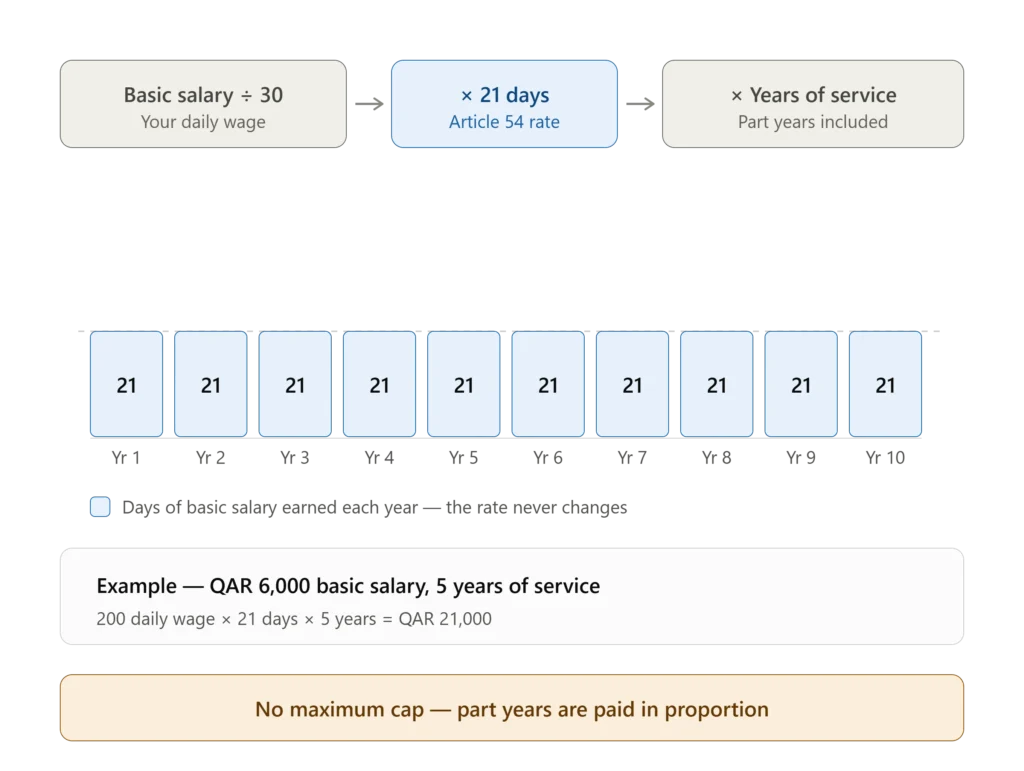
Gratuity = (Last Basic Salary ÷ 30) × 21 × Years of Service
Step 1 — Divide your basic salary by 30 to get your daily wage
Step 2 — Multiply by 21 days
Step 3 — Multiply by your years of service, including part years
The rate is a floor, not a ceiling. Article 54 sets three weeks’ basic salary per completed year as the legal minimum. Employers may agree to more — many pay 30 days — but never less.
Part years are statutory. Article 54 entitles you to gratuity for fractions of a year in proportion to time worked. Three years and six months is 3.5 years, not 3.
There is no maximum cap. Unlike the UAE, which caps gratuity at two years’ basic salary, Qatar sets no ceiling.
Does the Rate Increase After Five Years?
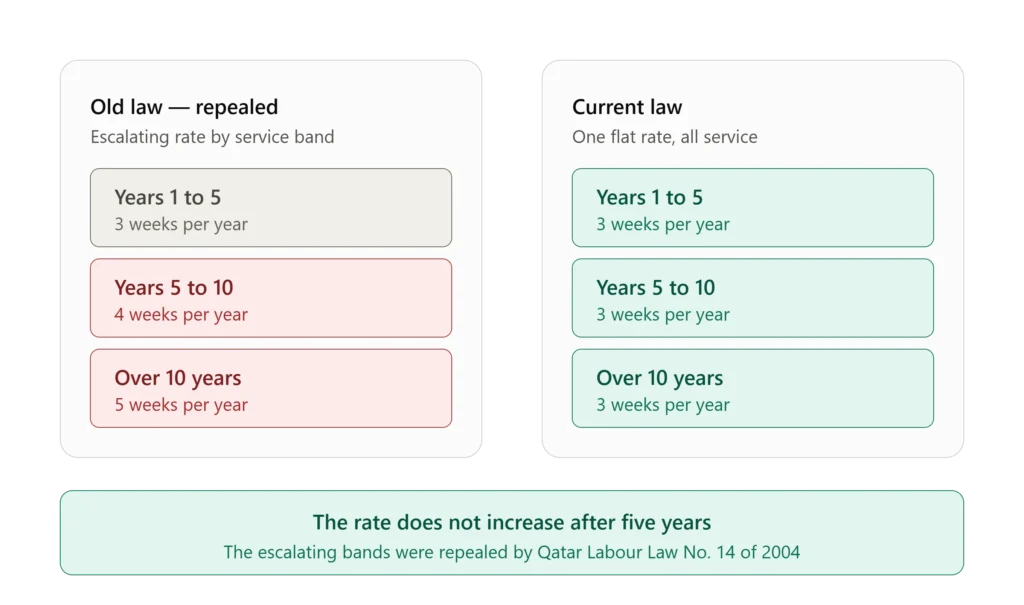
No — and this is the single most common error you will find online.
Under Qatar’s previous labour law, the rate rose with service: four weeks per year between five and ten years, and five weeks per year beyond ten.
That was repealed when Law No. 14 of 2004 came into force. The current law applies one flat rate of three weeks per year to all service, whether you have worked one year or twenty.
| Service period | Old law (repealed) | Current law |
|---|---|---|
| Years 1–5 | 3 weeks/year | 3 weeks/year |
| Years 5–10 | 4 weeks/year | 3 weeks/year |
| Over 10 years | 5 weeks/year | 3 weeks/year |
Several Qatar gratuity calculators still apply the old escalating rates. If a tool shows your figure jumping at year five, it is quoting a law that has not been in force for over twenty years — and giving you a number your employer will not pay.
21 Days or 30 Days? Check Your Contract
The statutory minimum is 21 days per year. But many employers in Qatar pay 30 days per year as a contractual benefit.
| Basis | QAR 6,000 basic · 5 years |
|---|---|
| 21 days (statutory minimum) | QAR 21,000 |
| 30 days (enhanced contractual) | QAR 30,000 |
That is a QAR 9,000 difference on the same service. Check your employment contract or company handbook before assuming the statutory figure is what you are owed. If your contract promises 30 days, that is enforceable — Article 54 sets the floor, and your contract can sit above it.
Note also that gratuity is normally calculated on a 30-calendar-day month. Some industries calculate on a working-day basis instead where that better fits their working patterns. Both are permitted, provided the result does not fall below the statutory minimum.
Which Salary Is Used
Included: basic salary only.
Excluded: housing allowance, transport allowance, food allowance, overtime, performance bonuses, commissions and other incentives.
Domestic workers — maids, drivers, nannies and cooks — fall under a different law. See Domestic Worker Gratuity Qatar.
Because many packages in Qatar are heavily weighted towards allowances, the gratuity figure is often far lower than people expect. On a QAR 15,000 package with QAR 7,000 basic, your gratuity is built on 7,000 — less than half.
A pay rise increases your gratuity retroactively. The calculation uses your last basic salary, not an average, so a raise shortly before you leave applies across your entire service period.
Who Qualifies
You are entitled to gratuity after one year of continuous service with the same employer.
- Contract type makes no difference. Fixed-term and open-ended contracts receive the same entitlement
- Expatriate and Qatari employees are treated identically under Article 54
- The same Labour Law applies throughout Qatar — Doha, Al Rayyan, Al Wakrah, Lusail and the industrial areas. Where you work does not change the calculation
- Under one year — no entitlement
- Gratuity cannot be waived by contract. No agreement can remove the Article 54 minimum from an eligible employee
Does Resigning Reduce Your Gratuity?
No. Qatar is clearer on this than most of the Gulf.
| How employment ends | Gratuity |
|---|---|
| Resignation after one year | Full |
| Termination by employer | Full |
| Contract expiry | Full |
| Retirement | Full |
| Dismissal under Article 61 | May be forfeited |
| Under one year of service | None |
Unlike Saudi Arabia, where resigning can cut the award to a third, Qatar applies the same formula regardless of who ended the employment. Only your completed service and last basic salary matter.
When Must Your Employer Pay?
At the date of termination. Article 54 requires the employer to pay the end-of-service gratuity, together with any other amounts due, when the employment ends.
Visa cancellation is a separate obligation. For non-Qatari employees, residency cancellation must be completed within two weeks of the end of employment under Article 57. Many companies link the gratuity payment to that process — but the two are legally distinct, and a pending visa cancellation is not a lawful reason to hold your settlement.
Settle before you leave the country. Recovering an unpaid settlement after departure is significantly harder.
The Two-Month Continuity Rule
Your service counts as continuous even if it was interrupted, provided the interruption was not a dismissal under Article 61 and you returned to work within two months.
This matters in sectors where contracts are briefly ended and restarted. Those years do not reset — and employees who assume they do routinely under-claim.
How Leave Affects Your Service Period
| Type of leave | Counts towards service? |
|---|---|
| Annual leave (paid) | ✅ Yes, in full |
| Maternity leave (paid) | ✅ Yes |
| Sick leave (paid) | ✅ Yes |
| Unpaid leave | ❌ Generally deducted |
Unpaid absence is normally excluded from the service period used for the calculation. Exactly how it is applied often depends on company policy, so check your handbook if you have taken extended unpaid leave.
Qatar Gratuity Calculation Examples
| Role | Basic salary | Service | Gratuity |
|---|---|---|---|
| Driver | QAR 2,500 | 3 years | QAR 5,250 |
| Cleaner | QAR 1,800 | 4 years | QAR 5,040 |
| Accountant | QAR 6,000 | 5 years | QAR 21,000 |
| Engineer | QAR 12,000 | 6 years | QAR 50,400 |
| Manager | QAR 20,000 | 8 years | QAR 112,000 |
Worked example — with a part year
QAR 5,000 basic · 3 years 6 months
- Daily wage: 5,000 ÷ 30 = QAR 166.67
- Per year: 166.67 × 21 = QAR 3,500
- Total: 3,500 × 3.5 = QAR 12,250
Those extra six months are worth QAR 1,750 on their own. Always check that part years appear on your settlement statement.
When Gratuity Can Be Lost (Article 61)
Article 61 sets out the specific circumstances in which an employer may dismiss without notice and without gratuity:
- Submitting forged documents or assuming a false identity
- Disclosing confidential company information
- Causing serious financial loss to the employer
- Assaulting the employer, a manager or a colleague at work
- Prolonged unexplained absence
- Conviction for an offence involving honour or honesty
Outside these defined situations, gratuity is a statutory entitlement and cannot be withheld.
Pension Schemes and Gratuity
Where you are covered by a pension or retirement scheme paying more than the statutory gratuity, the employer may provide the scheme benefit instead.
Where the scheme pays less, the employer is generally required to make up the difference to the Article 54 minimum.
This mainly affects Qatari nationals in the national pension system rather than expatriate staff. If you are in a company scheme, check how your contract handles the interaction.
Domestic Workers
Domestic workers fall under Law No. 15 of 2017, not the main Labour Law. Article 7 entitles housemaids, drivers, cooks, nannies and caregivers to end-of-service benefits of three weeks’ wages for each year of service — the same rate as private sector employees.
The calculation uses the worker’s agreed wage and completed service period.
What Else Is in Your Final Settlement
- Unpaid salary up to your last working day
- Leave encashment for unused annual leave
- Notice pay, where the employer ends the contract without requiring notice
- Repatriation ticket, where the contract provides for it
- Pending commission, bonuses or reimbursements
Employers may deduct debts. Outstanding loans, salary advances and other legally recoverable amounts can be taken from the settlement — but you are entitled to see every deduction itemised in writing.
Common Mistakes
Using your total package instead of basic salary. The most expensive error by a wide margin.
Believing the rate rises after five years. It does not. That was the old law.
Assuming 21 days is all you can get. Check your contract — many employers pay 30.
Rounding part years down. Three years and eleven months is not three years.
Assuming resignation cuts the amount. It does not, once you have completed a year.
Leaving at eleven months. Gratuity restarts with each employer. Moving jobs just before your first anniversary means no gratuity at all from that employer.
Why Your Employer’s Figure Might Differ
A different basic salary was used. Ask which figure they applied.
Unpaid leave was deducted. Ask how many days and from which period.
A deduction was applied. Loans, advances, or notice pay in lieu.
They used a working-day basis. Permitted in some industries, but the result must not fall below the statutory minimum.
Your contract has an enhanced rate. If HR used 21 days but your contract says 30, raise it.
A pension scheme applies. Check whether it replaces or supplements the gratuity.
If Your Employer Will Not Pay
1. Request the settlement in writing. Ask for an itemised statement showing the basic salary used, service dates, days applied and every deduction. Most disputes are resolved here.
2. Put your objection in writing. State your own calculation and that Article 54 requires payment at the date of termination. Keep the email thread.
3. Gather your documents. Employment contract and renewals, Qatar ID (QID), salary slips, Wage Protection System (WPS) records or bank statements showing salary transfers, and your resignation or termination letter. WPS records are the strongest evidence of what you were actually paid.
4. File a complaint with the Ministry of Labour (MOL). Complaints can be submitted through the MOL’s official channels. The Ministry reviews the case, contacts the employer and attempts to resolve it.
5. Escalate to the Labour Dispute Resolution Committee if the complaint is not settled.
Documentation decides these cases. An employee with a contract, payslips and a written objection is in a far stronger position than one relying on recollection.
Qatar Gratuity Calculator FAQs
How is gratuity calculated in Qatar?
Three weeks (21 days) of basic salary for each completed year of service, based on your last basic salary. Part years are paid pro rata.
Does the rate increase after five years?
No. The current law applies a flat three weeks per year to all service. The four-week and five-week rates belonged to the previous law and were repealed.
Is gratuity calculated on basic salary or total salary?
Basic salary only. Housing, transport, food, overtime and bonuses are excluded.
Do I get gratuity if I resign?
Yes, provided you have completed one year of continuous service.
What is the minimum service required?
One year of continuous service with the same employer.
When must my employer pay?
At the date of termination, under Article 54.
Is there a maximum gratuity limit in Qatar?
No. Qatar sets no cap.
Do part years count?
Yes. Article 54 entitles you to gratuity for fractions of a year in proportion to time worked.
Can my employer pay more than 21 days per year?
Yes. Article 54 is a minimum. Many contracts provide 30 days.
Does unpaid leave reduce my gratuity?
Yes, unpaid leave days are generally excluded from the service period, though application can depend on company policy.
Does annual leave reduce my gratuity?
No. Paid annual leave is part of your active service.
Is gratuity taxable in Qatar?
No. Qatar does not levy personal income tax on employment income.
Can my employer refuse to pay?
Only in the circumstances defined in Article 61.
Can my employer deduct money from my gratuity?
Yes, legally recoverable amounts such as loans and salary advances may be deducted.
Does gratuity transfer to a new employer?
No. Entitlement is calculated separately for each employer.
Are domestic workers entitled to gratuity?
Yes, under Article 7 of Law No. 15 of 2017 — three weeks’ wages per year of service.
What happens if an employee dies in service?
Outstanding salary, gratuity and other dues are paid to the legal heirs.
Does contract type affect gratuity?
No. Fixed-term and open-ended contracts receive the same entitlement.
Check Your Number Before You Sign
Your employer’s settlement statement is easier to question when you already have your own figure. It takes about a minute.
Last updated: August 2026
Sources: Qatar Labour Law No. 14 of 2004, Articles 54, 57 and 61 · Law No. 15 of 2017 on Domestic Workers, Article 7 · Ministry of Labour, Qatar
Written and maintained by Farhan — About
Disclaimer: This calculator provides an estimate for planning purposes and is not legal advice. Your final settlement depends on your contract, company policy and any enhanced terms. For a binding figure, contact the Ministry of Labour or a Qatar-licensed legal professional.