
Kuwait Gratuity Calculator 2026
Work out your end-of-service indemnity under Articles 51 to 53 of Kuwait Labour Law.
Indemnity (مكافأة نهاية الخدمة), also called gratuity or end-of-service benefit, is the lump sum your employer owes you when your employment in Kuwait ends. This free Kuwait gratuity calculator applies Law No. 6 of 2010 to your basic salary and service dates — including the resignation scale that most calculators leave out.
Required Inputs
Advanced (Optional)
Kuwait Gratuity Result
| Year | Period From | Period To | Days | Gratuity |
|---|---|---|---|---|
| No data | ||||
| Net Gratuity: | KWD 0.00 | |||
Estimate only — your final settlement may differ. See how the calculation works below.
Quick Answer
| Question | Answer |
|---|---|
| How much? | 15 days’ wage per year for the first 5 years, then one month per year |
| Does resigning reduce it? | Yes — on an indefinite contract. Nothing under 3 years, half at 3–5, two thirds at 5–10, full at 10+ |
| Is there a cap? | Yes — 18 months’ salary, under Article 51 |
| Which salary? | Basic monthly salary |
| 26 or 30-day month? | Kuwait practice is 26. Using 30 costs you about 15% |
| Minimum service? | Termination pays from year one. Resignation needs 3 years |
| Governing law | Articles 51, 53 and 41, Kuwait Labour Law No. 6 of 2010 |
How to Use This Calculator
Kuwait has more moving parts than most Gulf countries. Every input below changes your figure — including two that most calculators do not even ask for.
Daily wage basis — 26 or 30 days
This is the one most people get wrong. See the section below — it changes your figure by roughly 15%.
Joining date
Your first working day with this employer. Probation counts towards your service.
Last working date
Your final day of service, including any notice period you serve. Notice under Article 44 is three months for monthly-paid employees.
Basic monthly salary
Your last basic salary, not your total package. Housing, transport, bonuses and overtime are excluded.
Contract type
Indefinite or fixed. This matters only if you resign. On a fixed-term contract that runs to its end date, the Article 53 reduction does not apply.
Separation method
Termination always pays the full accrued indemnity. Resignation triggers the Article 53 scale on an indefinite contract.
Working in another Gulf country?
How to Calculate Indemnity in Kuwait (Article 51)
Step 1 — Work out your daily wage
Daily wage = Basic monthly salary ÷ 26Step 2 — Apply the two rate bands
| Service period | Rate per year |
|---|---|
| First 5 years | 15 days’ wage for each year |
| Year 6 onwards | One month’s wage for each year |
Year six is the milestone. Your accrual rate jumps by about three quarters the moment you pass five years — which is why resigning at four years and eleven months is an expensive decision. — which is why resigning at four years and eleven months is an expensive decision.
Partial years are paid in proportion, calculated to the exact day.
Step 3 — Check the 18-month cap
Article 51 caps total indemnity at 18 months’ salary, no matter how long you have worked. The cap applies to resignation and termination alike, and typically bites at around 20 years of service.
If you are paid daily, weekly or hourly
Article 51 sets a different scale for workers paid on a daily, weekly, hourly or piece-rate basis: 10 days’ wage for each of the first five years and 15 days for each year after, capped at one year’s pay rather than 18 months.
This calculator uses the monthly-paid scale, which covers most private sector employees.
26 Days or 30 Days? The Difference Costs You 15%
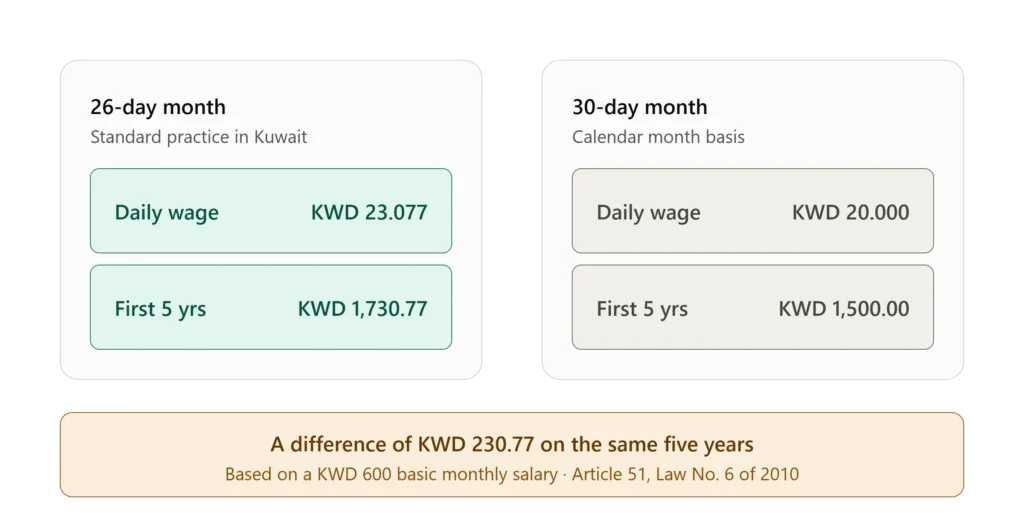
Article 51 grants “15 days’ remuneration” for each of the first five years — but the law does not spell out how to convert a monthly salary into a daily one. In Kuwait, the working month is treated as 26 days, so your daily wage is your monthly salary divided by 26.
Some employers divide by 30 instead. It looks like a technicality. It is not.
On a KWD 600 salary with 5 years of service:
| Basis | Daily wage | First 5 years |
|---|---|---|
| 26 days (Kuwait practice) | KWD 23.077 | KWD 1,730.77 |
| 30 days (calendar month) | KWD 20.000 | KWD 1,500.00 |
A difference of KWD 230.77 — for the same job, the same salary and the same five years.
The calculator above lets you switch between the two so you can see both figures. Run the 26-day calculation, then compare it with your employer’s statement. If they used 30, ask which provision they relied on.
Note that the second band is different. Article 51 grants “one month’s remuneration” for years beyond five, which is simply your monthly salary — no daily conversion is needed, so the 26-versus-30 question does not apply to that part.
Does Resigning Reduce Your Indemnity? (Article 53)
Yes — and Kuwait is stricter about this than the UAE, where resigning does not reduce your gratuity at all.
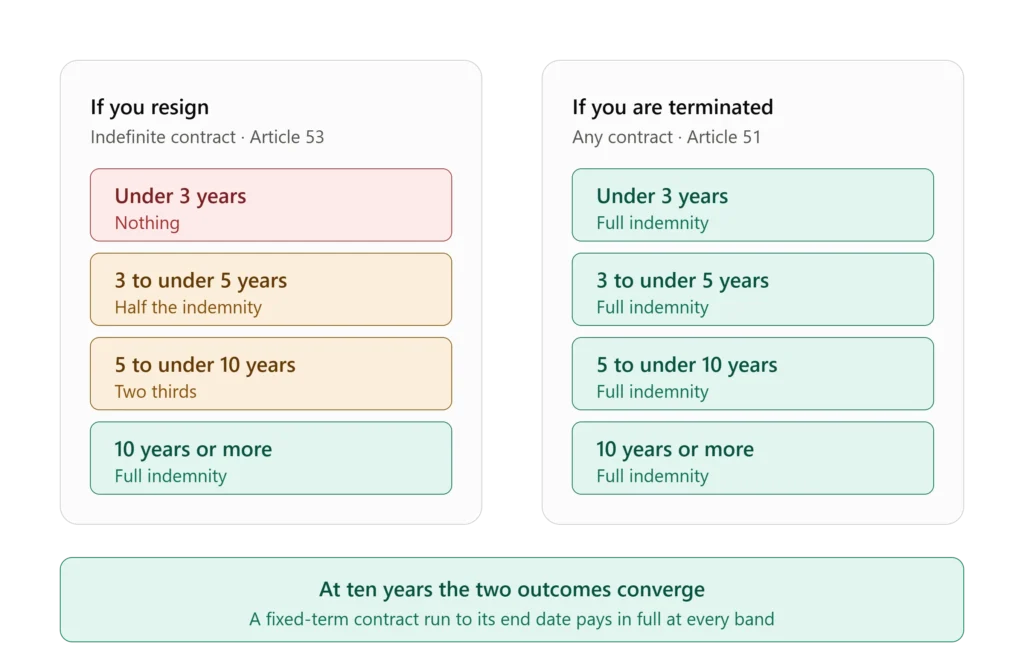
The resignation scale on an indefinite contract
| Completed service | Entitlement on resignation |
|---|---|
| Under 3 years | Nothing |
| 3 to under 5 years | Half the indemnity |
| 5 to under 10 years | Two thirds |
| 10 years or more | Full indemnity |
At ten years the two outcomes converge — resigning and being terminated pay exactly the same.
The three-year threshold is the one to plan around
Resigning at two years and eleven months from an indefinite contract pays zero. One month later it pays half. On a KWD 600 salary that single month is worth around KWD 520.
If you are approaching three, five or ten years, calculate both sides of the line before you hand in your notice.
Saudi Arabia applies a similar scale, though its thresholds fall at different points.
Fixed-term contracts work differently
The Article 53 reduction applies to indefinite contracts. Where a fixed-term contract runs to its agreed end date, the full indemnity is payable — there is no resignation scale to apply.
Check which type of contract you signed before assuming a reduction applies to you.
When You Receive the Full Indemnity Regardless
Female employees who resign after marriage
A female employee who ends her contract because of her marriage, within one year of the marriage date, is entitled to the full indemnity — the Article 53 scale does not apply.
Very few calculators account for this, and it can be the difference between nothing and a full payout.
Retirement, disability and death
Employees who reach retirement age, become disabled through work, or die in service receive the full indemnity, and in the case of death it is paid to the legal heirs.
Worked Examples
All figures use the 26-day basis.
KWD 600 · 7 years · terminated
- First 5 years: 5 × 15 × 23.077 = KWD 1,730.77
- Years 6–7: 2 × 600 = KWD 1,200.00
- Total: KWD 2,930.77
KWD 600 · 7 years · resigned from an indefinite contract
- Full accrual: KWD 2,930.77
- Article 53 (5–10 years): two thirds
- Payable: KWD 1,953.85
The same seven years. Resigning costs KWD 976.92.
KWD 400 · 4 years · resigned
- Full accrual: 4 × 15 × 15.385 = KWD 923.08
- Article 53 (3–5 years): half
- Payable: KWD 461.54
KWD 1,000 · 25 years · terminated
- First 5 years: 5 × 15 × 38.462 = KWD 2,884.62
- Years 6–25: 20 × 1,000 = KWD 20,000
- Accrued total: KWD 22,884.62
- Article 51 cap: 18 × 1,000 = KWD 18,000
- Payable: KWD 18,000
Long service eventually hits the ceiling. Beyond roughly twenty years, extra years add nothing.
Who Qualifies for Kuwait Indemnity
Expatriate employees
Expatriate employees under Kuwait Labour Law have the same entitlement as Kuwaiti nationals. Nationality does not change the Article 51 formula or the Article 53 scale.
Kuwaiti nationals and the PIFSS offset
Kuwaiti nationals are enrolled in the Public Institution for Social Security. Where an employer has been paying social insurance contributions on your behalf, it may set those contributions off against the indemnity due.
If you are Kuwaiti, ask for the offset to be shown as a separate line on your settlement statement rather than absorbed into a single figure.
Which Salary Is Used
Included: basic monthly salary as stated in your employment contract.
Excluded: housing allowance, transport allowance, performance bonuses, sales commission and overtime.
Where an allowance is paid regularly and is treated as part of your remuneration under your contract, it may form part of the calculation base. This is contract-specific, so read what your contract actually says rather than assuming.
Because many Kuwaiti packages are weighted towards allowances, the indemnity figure is often well below what people expect from their total monthly income.
When Indemnity Can Be Lost (Article 41)
Article 41 sets out the circumstances in which an employer may dismiss an employee without notice and without indemnity. These are specific and serious — they are not a general discretion.
Outside those grounds, indemnity is a statutory entitlement. It cannot be withheld as leverage during your exit, and it cannot be signed away in an employment contract.
What Else Is in Your Final Settlement
Indemnity is one line in a larger settlement. You may also be owed:
- Unpaid salary to your last working day
- Encashment of unused annual leave
- Notice pay, where the employer ends the contract without requiring you to serve notice
- A repatriation ticket, where your contract provides for it
- Pending commission, bonuses or reimbursements
Deductions for loans, salary advances or other legally recoverable amounts may be applied — but you are entitled to see each one itemised.
Common Indemnity Calculation Mistakes
Accepting a 30-day daily wage without question. Costs roughly 15% on your first five years.
Not knowing which contract type you signed. The Article 53 reduction applies to indefinite contracts. On a fixed-term contract that ran its course, it does not.
Resigning just before a threshold. Three, five and ten years each change your entitlement materially.
Using your total package instead of basic salary.
Assuming termination and resignation pay the same. They only converge at ten years.
Female employees not claiming the marriage provision. Resigning within a year of marriage attracts the full indemnity.
Rounding part years down. Indemnity is calculated to the exact day.
Why Your Employer’s Figure Might Differ
They used a 30-day basis. Ask which provision supports it.
They applied Article 53 to a fixed-term contract. The reduction is for indefinite contracts.
They used a different basic salary. A mid-employment restructure, or an HR record that does not match your contract.
The 18-month cap was applied. Check whether your accrued total actually exceeded it.
A PIFSS offset was applied. Relevant to Kuwaiti nationals.
Deductions were absorbed silently. Ask for the itemised breakdown.
If Your Employer Will Not Pay
1. Request the settlement in writing. Ask for an itemised statement showing the basic salary used, the daily wage basis, service dates, the Article 53 factor applied and every deduction.
2. Put your objection in writing. State your own calculation and cite Articles 51 and 53. Keep the email thread.
3. Gather your documents. Employment contract and renewals, Civil ID, salary slips, bank statements showing salary transfers, leave balance records, and your resignation or termination letter.
4. File a complaint with the Public Authority for Manpower (PAM). PAM handles private sector labour disputes and can be reached on 103. It will contact the employer and attempt to settle the matter.
5. Escalate to the labour court if PAM cannot resolve it. Cases referred by PAM proceed through the court system.
Do not sign a release document before you are satisfied with the figure. A signed settlement is considerably harder to reopen.
Kuwait Gratuity Calculator FAQs
How is indemnity calculated in Kuwait?
Fifteen days’ wage for each of the first five years, then one month’s wage for each year after that, based on your last basic salary. The total is capped at 18 months’ salary.
Should my daily wage be my salary divided by 26 or 30?
Kuwaiti practice divides by 26, treating the working month as 26 days. Dividing by 30 produces a figure about 15% lower for the first five years.
Do I lose my indemnity if I resign?
On an indefinite contract, partly. Nothing under three years, half from three to five, two thirds from five to ten, and the full amount at ten years or more.
What is the maximum indemnity in Kuwait?
Eighteen months’ salary, under Article 51.
Does contract type affect my indemnity?
Yes. The Article 53 resignation reduction applies to indefinite contracts. A fixed-term contract that runs to its end date pays the full amount.
Is indemnity calculated on basic salary or total salary?
Basic monthly salary. Allowances are generally excluded unless your contract treats them as part of remuneration.
Do part years count?
Yes. Indemnity is calculated to the exact day.
What happens if I am terminated?
Termination other than for misconduct pays the full accrued indemnity, regardless of length of service.
Do female employees have different rights?
A female employee who resigns because of marriage, within one year of the marriage date, receives the full indemnity.
Do expatriates receive indemnity in Kuwait?
Yes. The same rules apply regardless of nationality.
Is indemnity taxable in Kuwait?
There is no personal income tax on employment income in Kuwait.
How much notice must I give?
Three months for monthly-paid employees, under Article 44.
Can my employer refuse to pay?
Only in the dismissal circumstances set out in Article 41.
Where do I complain if I am not paid?
The Public Authority for Manpower, on 103.
Check Your Number Before You Resign
In Kuwait, three years, five years and ten years each change what you are owed. Knowing your figure before you hand in notice can be worth thousands of dinars.
Last updated: August 2026
Sources: Kuwait Labour Law No. 6 of 2010, Articles 41, 44, 51 and 53 · Public Authority for Manpower (PAM)
Written and maintained by Farhan — About
Disclaimer: This calculator provides an estimate for planning purposes and is not legal advice. Your final settlement depends on your contract, your contract type and the daily wage basis your employer applies. For a binding figure, contact the Public Authority for Manpower on 103 or a Kuwait-licensed legal professional.