
Kuwait Gratuity Guide 2026: Complete End-of-Service Benefits
Understanding your end-of-service benefits is important if you are working in Kuwait. Whether you are planning to resign, change jobs, or complete your employment contract, knowing how gratuity works can help you understand your rights and estimate your final settlement accurately.
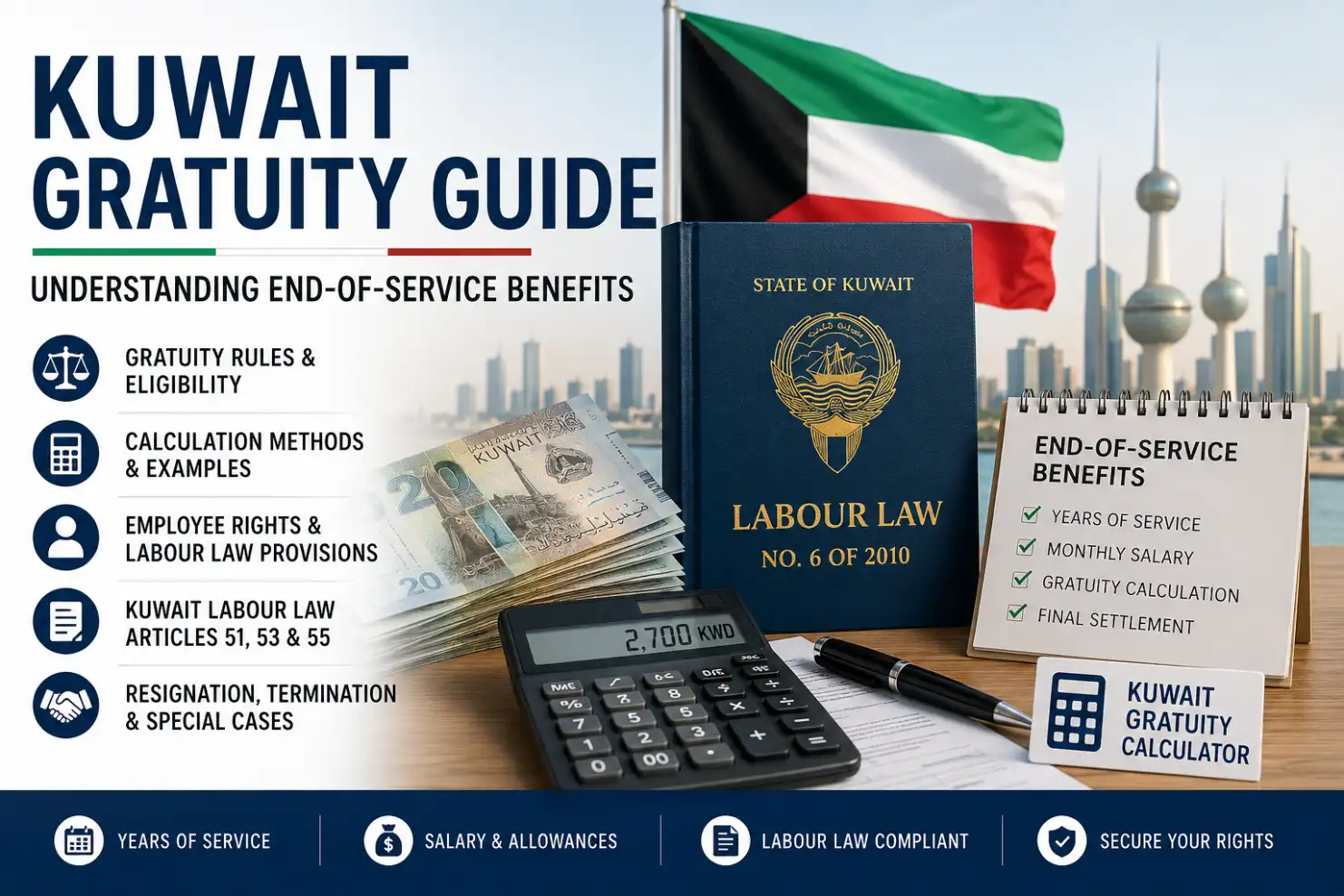
This Kuwait Gratuity Guide covers gratuity rules, eligibility requirements, calculation methods, employee rights, and key labour law provisions that affect end-of-service benefits in Kuwait. It also explains how a Kuwait Gratuity Calculator can help estimate your gratuity entitlement based on your salary and years of service.
Kuwait Gratuity Guide: Understanding End-of-Service Benefits
Gratuity, also known as End-of-Service Benefits (EOSB) or end-of-service indemnity, is a financial payment that employers must provide to eligible employees when their employment ends. The purpose of gratuity is to reward employees for their service and provide financial support after leaving a job.
In Kuwait, gratuity is governed by Labour Law No. 6 of 2010. The law establishes how end-of-service benefits should be calculated and outlines the responsibilities of employers and employees. Most private-sector workers who meet the eligibility requirements are entitled to receive gratuity when their employment relationship ends.
Why Kuwait Gratuity Matters
For many employees, gratuity represents one of the most valuable employment benefits they will receive during their careers. Depending on salary and years of service, the final payment can be significant and may help support future financial plans.
Many workers focus only on their monthly salary and overlook the value of end-of-service benefits. However, gratuity can provide an important financial cushion when transitioning between jobs or preparing for retirement.
Who Is Eligible for Kuwait Gratuity?
Most private-sector employees working under Kuwait Labour Law are eligible for end-of-service benefits after completing the required service period. Eligibility generally depends on the employee’s years of service, employment contract, and the circumstances of separation.
Employees who complete at least one year of continuous service are generally entitled to gratuity benefits. The final entitlement depends on whether the employee resigns, is terminated, or completes a fixed-term contract.
Kuwait Gratuity Calculation Formula
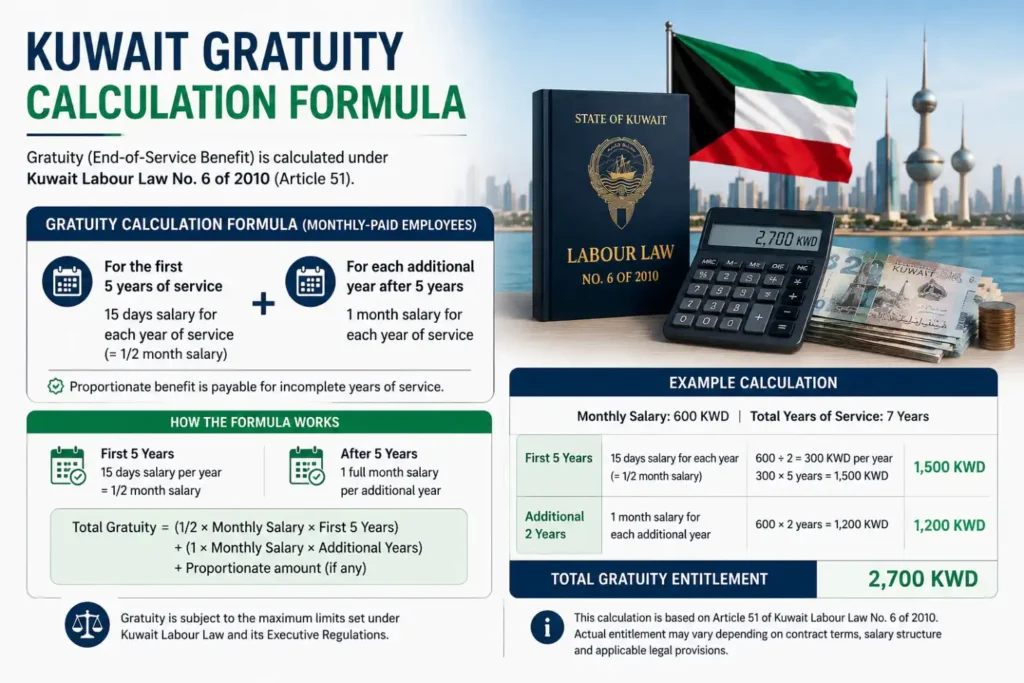
The amount of gratuity paid depends primarily on the employee’s salary and total years of service. Kuwait Labour Law provides a specific framework for calculating end-of-service benefits.
For monthly-paid employees, gratuity is generally calculated as 15 days of salary for each of the first five years of service and one month of salary for every additional year thereafter. Employees may also receive a proportional benefit for incomplete years of service.
The total gratuity amount is subject to limits established under labour regulations. Accurate calculations require consideration of salary structure, service duration, and employment status.
Example of Kuwait Gratuity Calculator
Before calculating benefits manually, many workers prefer using a Kuwait Gratuity Calculator to get a quick estimate based on their salary and years of service. This helps employees understand their potential entitlement before employment ends.
Consider an employee earning a monthly salary of 600 KWD who has worked for seven years.
For the first five years, the employee earns 15 days of salary for each year of service. Since 15 days represent half a month’s salary, the employee earns 300 KWD per year for five years, resulting in 1,500 KWD.
For the additional two years, the employee earns one full month of salary for each year. This results in 600 KWD multiplied by two years, producing 1,200 KWD.
The total gratuity entitlement would therefore be 2,700 KWD.
Kuwait Gratuity for Resignation
Employees who voluntarily resign may still qualify for gratuity depending on their length of service. The percentage of gratuity payable generally increases as the employee completes more years with the same employer.
Employees who resign before completing three years of service are generally not entitled to gratuity. Those who complete between three and five years of service may receive 50% of their entitlement.
Employees who complete between five and ten years of service may receive approximately two-thirds of their gratuity entitlement. Workers who complete ten years or more are generally entitled to receive their full gratuity amount.
Kuwait Gratuity for Termination
When an employer terminates an employee, the employee is generally entitled to receive the full gratuity amount earned during the service period. The payment is calculated according to salary and completed years of service.
In addition to gratuity, employees may also be entitled to unpaid wages, compensation for unused annual leave, and other contractual benefits. Employers are expected to settle these obligations promptly and accurately.
Timely payment of end-of-service benefits helps employers remain compliant with labour regulations while maintaining positive employee relations.
Article 51 of Kuwait Labour Law
Article 51 is one of the most important provisions governing end-of-service benefits in Kuwait. The article establishes the framework used to
calculate gratuity for employees.
For monthly-paid workers, the law provides 15 days of remuneration for each of the first five years and one month’s remuneration for every year thereafter. Employees are also entitled to proportional benefits for fractions of a year worked.
The article further states that certain outstanding obligations may be deducted from gratuity where legally permitted.
Article 53 and Resignation Benefits
Article 53 explains how gratuity is treated when employees voluntarily terminate their employment contracts. The law provides reduced gratuity benefits for employees who resign before reaching specific service milestones.
The purpose of this provision is to balance employee rights with the employer’s investment in long-term employment relationships. Employees who remain with the same employer for longer periods generally receive a larger percentage of their gratuity entitlement.
Understanding these provisions can help employees make informed decisions before submitting a resignation.
Article 55 and Salary Components
Article 55 defines remuneration and clarifies which salary elements may be considered when determining employee compensation. Understanding this article is important because salary components can influence gratuity calculations.
The law recognizes recurring payments such as allowances, benefits, bonuses, and other forms of compensation. Employees should review their contracts carefully to understand how remuneration is structured.
A clear understanding of salary components can help employees verify whether gratuity calculations have been performed correctly.
Female Employee Gratuity Rights in Kuwait
Kuwait Labour Law includes provisions that may grant additional protections to female employees in certain situations. Under specific circumstances, a female employee who resigns after marriage may still qualify for full gratuity benefits.
These provisions are designed to protect employees experiencing significant life changes. Employees who believe these rules apply to their situation should review the relevant labour law provisions carefully.
Understanding these rights can help ensure that eligible employees receive the benefits to which they are entitled.
Factors That Affect Kuwait Gratuity Calculations
Several factors can influence the final gratuity amount received by an employee:
- Length of service
- Monthly salary
- Employment contract type
- Resignation or termination status
- Salary structure and remuneration components
- Applicable labour law provisions
Each of these factors plays an important role in determining the final end-of-service benefit amount.
Common Gratuity Calculation Mistakes
Many employees fail to maintain proper employment records, making it difficult to verify gratuity calculations. Missing salary documents and incomplete service records can create disputes during final settlements.
Another common mistake is assuming that resignation and termination produce the same gratuity entitlement. Labour law provisions often treat these situations differently.
Employees should always request a detailed gratuity breakdown before accepting a final settlement. Reviewing calculations carefully can help identify potential errors.
How Employers Manage End-of-Service Benefits
Employers are responsible for calculating gratuity accurately and maintaining records that support final settlements. Proper documentation is essential because gratuity calculations depend on salary history and service duration.
Accurate record-keeping also helps employers remain compliant with labour regulations and simplifies audit processes. Failure to manage gratuity correctly may lead to legal complications and financial penalties.
Maintaining transparency throughout the process benefits both employers and employees.
How This Kuwait Gratuity Guide Can Help Employees
Understanding gratuity rules can help employees plan for the future and verify settlement calculations. Employees who understand the law are better equipped to protect their rights and avoid financial surprises.
Using a Kuwait Gratuity Calculator alongside official labour law guidance can provide a clearer picture of expected benefits. While calculators offer useful estimates, employees should still verify the final amount according to Kuwait Labour Law and their employment contract. However, employees should always compare calculations with current legal requirements.
Being informed allows workers to approach resignation, termination, and retirement with greater confidence.
Frequently Asked Questions
What is gratuity in Kuwait?
Gratuity is a legally required end-of-service payment provided to eligible employees when their employment ends.
Who qualifies for gratuity in Kuwait?
Most private-sector employees who complete the required service period under Kuwait Labour Law qualify for gratuity benefits.
Is gratuity paid when an employee resigns?
Yes, although the amount may depend on the employee’s years of service and applicable labour law provisions.
Is gratuity paid when an employee is terminated?
In most cases, terminated employees are entitled to receive their full gratuity entitlement.
How is gratuity calculated in Kuwait?
Gratuity is generally calculated using salary and total years of service according to Labour Law provisions.
Can employers deduct money from gratuity?
Certain deductions may be permitted if allowed under labour regulations and supported by documentation.
Do female employees receive special gratuity benefits?
Specific provisions may allow female employees to receive full gratuity benefits in qualifying circumstances.
What should I do if my gratuity calculation seems incorrect?
Employees should request a detailed breakdown and seek professional guidance if they believe an error has occurred.
Final Thoughts
This Kuwait Gratuity Guide provides a comprehensive overview of end-of-service benefits in Kuwait and explains the key labour law provisions that affect gratuity calculations. Employees who want a quick estimate of their benefits can use our Kuwait Gratuity Calculator to calculate their expected end-of-service settlement based on salary and years of service.
Because gratuity is often one of the largest employment-related payments an employee receives, it is important to understand how calculations work and what rights apply under Kuwait Labour Law. Staying informed and using a Kuwait Gratuity Calculator when needed can help ensure that employees receive the compensation they have earned through years of dedicated service.