
UAE Gratuity Calculator 2026
Work out your end-of-service benefit in under a minute — updated for Federal Decree-Law No. 33 of 2021.
This free UAE gratuity calculator works out your end-of-service benefit under Federal Decree-Law No. 33 of 2021. Enter your basic salary and service dates, and you get a year-by-year breakdown you can download and take to HR.
Gratuity (مكافأة نهاية الخدمة) is often the largest single payment an expatriate employee receives from a UAE employer, and the figure HR gives you is not always right.
Required Inputs
Advanced (Optional)
UAE Gratuity Result
| Year | Period From | Period To | Days | Gratuity |
|---|---|---|---|---|
| No data | ||||
| Net Gratuity: | AED 0.00 | |||
Estimate only — your final settlement may differ. See how the calculation works below.
Current Law 2026
Decree-Law 33 of 2021
Detailed Reports
Calculation Breakdown
PDF Export & Snapshot
Download Detailed Results
Labour Law Based
Updated Regulations
How to Use This UAE Gratuity Calculator
Most wrong gratuity estimates come from entering the wrong number, not from the formula. Here is where each figure comes from.
Basic salary
Use the amount written as basic salary or basic wage in your employment contract — not your total monthly package.
Example: If your contract shows AED 12,000 total made up of AED 7,000 basic, AED 3,500 housing and AED 1,500 transport, the number you enter is 7,000.
If your salary was revised during your employment, use the basic salary that applied on your last working day.
Labour Law Version
Leave this on Current Law (Decree-Law No. 33 of 2021).
Only switch to Old Law (Federal Law No. 8 of 1980) if your employment ended before February 2022, or you are checking an old settlement against the rules that applied at the time.
First working day
Your original joining date — not the start date of your most recent contract renewal. Renewed contracts count as one continuous period of service.
Last working day
The final day of your notice period, not the day you submitted your resignation. Notice period days are part of your service.
Unpaid leave days (optional)
Enter any days of unpaid absence during your employment. These are subtracted from your service period before the calculation runs.
Notice pay deduction (optional)
If you are leaving without serving your full notice period, enter the amount your employer will deduct in lieu of notice. This is subtracted from your final pay out.
Press Calculate to see your gratuity with a year-by-year breakdown. Export it as PDF or Excel, or save the result to compare different resignation dates before you decide.
Working in another Gulf country?
Gratuity rules differ across the GCC. Use the calculator built for your country:
How to Calculate Gratuity in the UAE (2026 Formula)
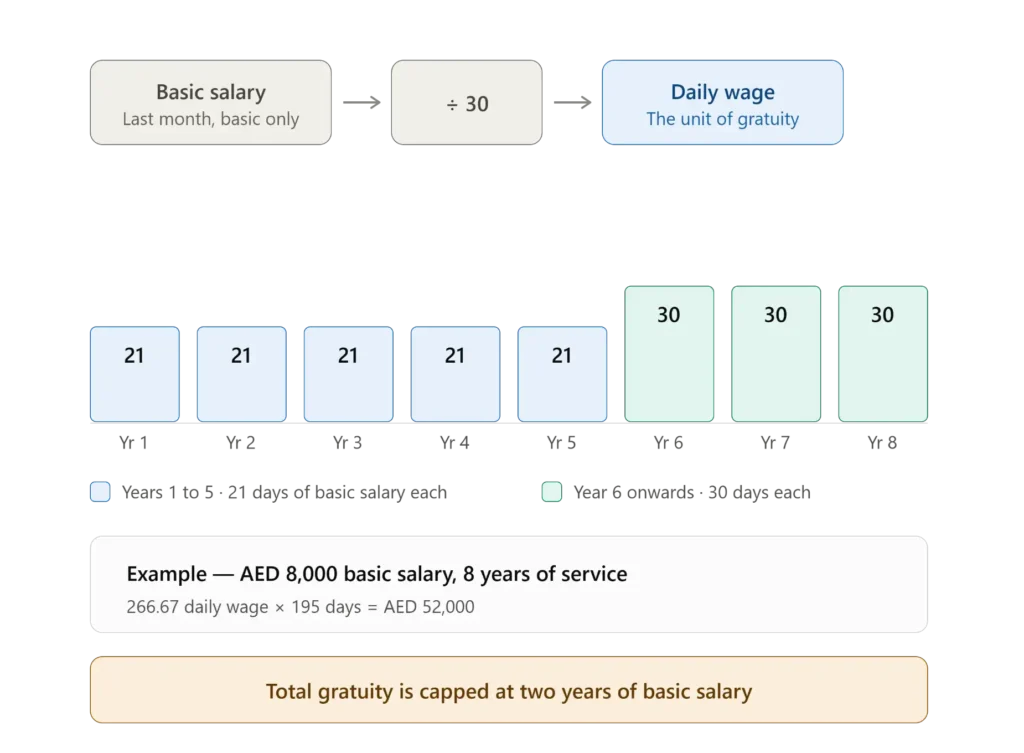
UAE end-of-service gratuity is calculated on your last basic salary only. Housing allowance, transport allowance, utilities, furniture allowance, commission, overtime and bonuses are all excluded.
In short: UAE gratuity is 21 days of basic salary for each of your first five years, then 30 days for every year after that, capped at two years’ basic salary. Resigning does not reduce it.
Step 1 — Daily wage
Daily wage = Basic salary ÷ 30
Step 2 — Eligible days
| Service period | Days of basic salary per year |
| Under 1 year | No gratuity |
| 1 to 5 years | 21 days for each year |
| Over 5 years | 21 days for each of the first 5 years, then 30 days for every year after |
Step 3 — Multiply
Gratuity = Daily wage × Total eligible days
The cap. However long you have worked, total gratuity cannot exceed two years’ basic salary under Article 51 of Federal Decree-Law No. 33 of 2021.
Part years are paid pro-rata. Once you complete your first full year, additional months count proportionally. Nine extra months on the 21-day band works out to roughly 15.75 days.
Unpaid leave is excluded. Days of unpaid absence do not count towards your continuous service period.
Part-time and flexible workers receive a proportionate share: contracted annual hours divided by full-time annual hours gives a percentage, which is applied to the full-time figure.
Lawful deductions. Your employer may deduct any amounts you legitimately owe the company before paying the balance.
Who Qualifies for UAE Gratuity
You are entitled to gratuity if you have completed at least one continuous year with the same employer, you are a full-time private sector employee under MOHRE jurisdiction, and you were not dismissed on one of the gross misconduct grounds set out in Article 44 of the UAE Labour Law.
Probation counts towards your service once you are confirmed, because your joining date marks the start of continuous service.
UAE and GCC nationals are covered by national pension and social security arrangements instead, so this calculator is aimed at expatriate employees.
Domestic workers — nannies, drivers, cooks and household staff — are covered under the Domestic Workers Law and are also entitled after one year of service.
Temporary employment of under one year does not qualify.
If an employee dies in service after completing one year, the gratuity is payable to their legal heirs.
Does Resigning Reduce Your UAE Gratuity?
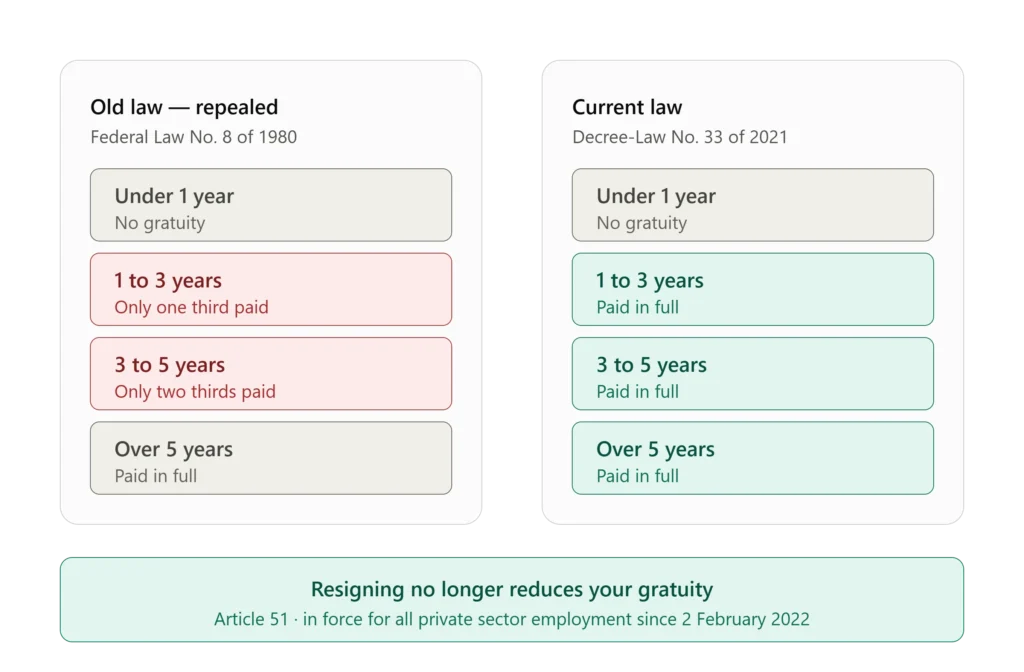
Under the current law, no. This is the most misunderstood point in UAE end-of-service benefits, and much of the advice still circulating online is out of date.
Under the old Federal Law No. 8 of 1980, an employee who resigned early received only part of their gratuity: one third of it between one and three years of service, and two thirds between three and five years. On a limited-term contract, resigning before five years forfeited it entirely.
That rule was abolished. Under Federal Decree-Law No. 33 of 2021, in force for all private sector employment since 2 February 2022, resignation and termination are calculated identically. Complete one year and resign, and you receive your full 21-day or 30-day entitlement.
| Service period | Resignation | Termination |
|---|---|---|
| Under 1 year | No gratuity | No gratuity |
| 1 to 5 years | 21 days per year — full | 21 days per year — full |
| Over 5 years | 21 days per year for first 5, then 30 days | Same |
One exception worth knowing: All unlimited contracts were required to be converted to fixed-term contracts. If an employee somehow remained on an unconverted legacy unlimited contract, the older reduction scale could still be argued in a dispute — which is why this calculator lets you compare both law versions side by side.
What still reduces your pay out: leaving without serving your contractual notice period. Payment in lieu of notice is deducted from the settlement. Your gratuity entitlement is unchanged — the amount reaching your account is not.
Limited vs Unlimited Contracts
Since the 2021 law took effect, all private sector employees in the UAE are on fixed-term contracts. Unlimited contracts were phased out and had to be converted.
For gratuity purposes this changes nothing between them: both use the same 21/30-day calculation. Any website showing separate gratuity formulas for limited and unlimited contracts is describing the position before February 2022.
Contract type still affects notice periods, early termination compensation and renewal terms — just not how your gratuity is calculated.
UAE Gratuity Calculator: Worked Examples by Salary
AED 3,000 basic salary · 2 years of service
Daily wage AED 100 × (21 × 2 = 42 days) = AED 4,200
AED 5,000 basic salary · 3 years of service
Daily wage AED 166.67 × (21 × 3 = 63 days) = AED 10,500
AED 10,000 basic salary · 5 years of service
Daily wage AED 333.33 × (21 × 5 = 105 days) = AED 35,000
AED 8,000 basic salary · 8 years of service
Daily wage AED 266.67 × ((21 × 5) + (30 × 3) = 195 days) = AED 52,000
Working on a different salary? See our detailed breakdowns for AED 5,000 salary, AED 8,000 salary, AED 10,000 and AED 15,000 — or [browse all salary guides].
Free Zone Gratuity Rules: JAFZA, DMCC, DIFC and ADGM
Where you work determines whether you receive a gratuity lump sum at all.
Free zones following standard UAE Labour Law — JAFZA, DMCC, DAFZA, Dubai South, SAIF Zone and most others — apply exactly the 21/30-day calculation above. The calculator on this page applies to you.
Employees in Dubai, Abu Dhabi and Sharjah all use the same federal calculation — the emirate you work in does not change your gratuity.
DIFC works differently. Since 2020, DIFC has replaced end-of-service gratuity with DEWS (DIFC Employee Workplace Savings).
Rather than a lump sum at the end, your employer pays monthly contributions into a funded plan — 5.83% of basic salary for the first five years of service, and 8.33% thereafter. What you receive on leaving is your accumulated contributions plus investment returns, not a gratuity calculation.
ADGM operates under its own employment regulations and permits employers to enrol staff in an approved savings scheme in place of traditional gratuity.
The federal formula is identical across the emirates. Whether you work in Dubai, Abu Dhabi, Sharjah, Ajman, Ras Al Khaimah, Fujairah or Umm Al Quwain, the calculation is the same. Only DIFC and ADGM sit outside the federal system.
Check your contract before relying on any figure. If it references DIFC or ADGM regulations, or names a workplace savings scheme, the number from this calculator will not match what you actually receive.
The Alternative End-of-Service Savings Scheme
Under Cabinet Resolution No. 96 of 2023, mainland employers may opt into a voluntary MOHRE-approved savings scheme instead of paying a lump sum. Any gratuity accrued before joining is calculated under Article 51 and frozen.
Most UAE employers still use the traditional system. Ask HR if you are unsure which applies to you.
When Must Your Employer Pay Your Gratuity?
Within 14 days of your contract ending. Article 53 of Federal Decree-Law No. 33 of 2021 requires the employer to settle all end-of-service entitlements — gratuity, unpaid wages, leave encashment and other dues — within fourteen days of the termination date.
If your employer is past that deadline without lawful reason, you have grounds to raise it formally.
What Else Is in Your Final Settlement?
Gratuity is one line in a larger full and final settlement. Depending on your contract, you may also be owed:
- Unpaid salary up to your last working day
- Leave encashment for unused annual leave, paid at basic salary rate
- Notice pay, where your employer ends the contract without requiring you to serve notice
- A repatriation air ticket to your home country, where the contract provides for it
- Contractual entitlements such as pending commission, bonuses or reimbursements
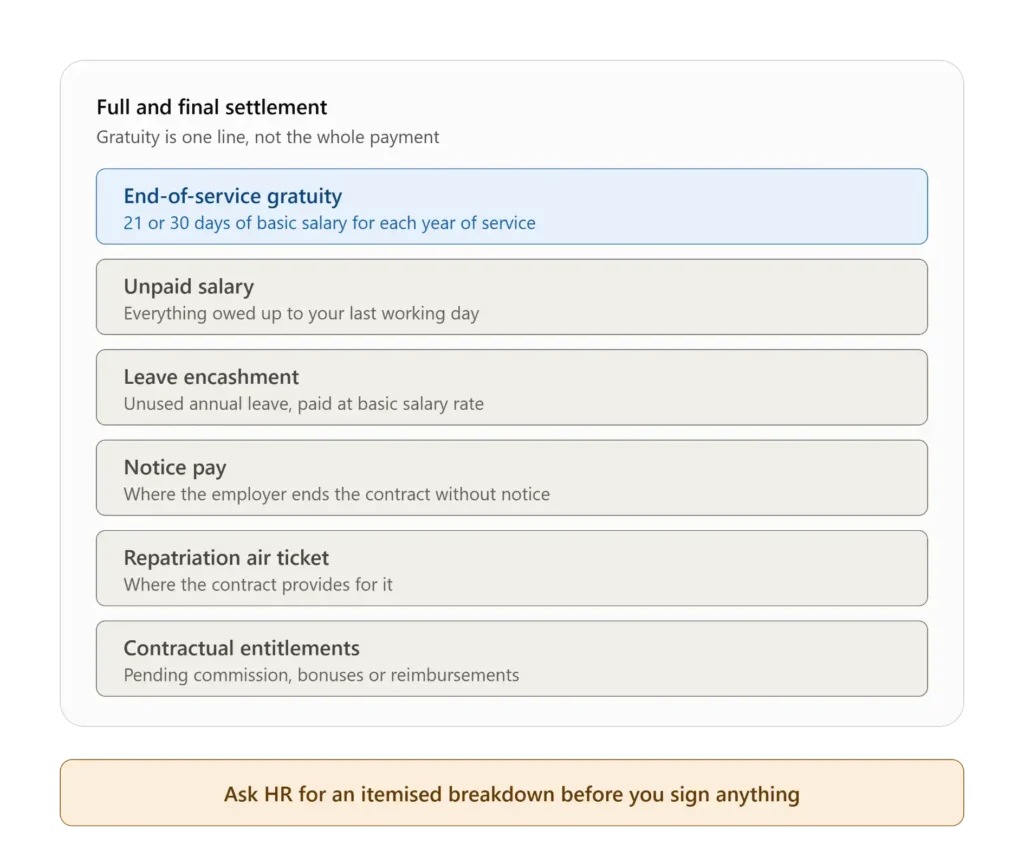
Ask HR for a written, itemised breakdown before signing anything. You cannot dispute a figure you have never seen written down.
Common Gratuity Calculation Mistakes
Using your total package instead of basic salary: The single most expensive error. Someone on an AED 12,000 package with AED 7,000 basic who enters 12,000 will see a figure roughly 70% higher than what they will actually receive — and walk into a settlement meeting expecting money that was never owed.
Entering the resignation date instead of the last working day: Your notice period counts as service. Submitting your resignation on 1 March with a 60-day notice means your service runs to 30 April, not 1 March.
Counting from the latest contract renewal: Renewals are continuous service. An employee on their third two-year contract has six years of service, not two — and the difference between the 21-day and 30-day band starts at year five.
Assuming resignation reduces the amount: It does not under the current law. This one costs the most, because employees accept a reduced offer without questioning it.
Rounding partial years down: Four years and eight months is not four years. Every additional month is paid pro-rata.
Assuming allowances count: Housing, transport, utilities, furniture, commission, overtime and bonuses are all excluded, no matter how large they are.
Relying on outdated websites: A surprising number of UAE gratuity pages still apply the old one-third and two-thirds resignation scale, and still cite Article 120 for misconduct dismissals.
Both belong to Federal Law No. 8 of 1980, which was repealed. The current provisions are Articles 44 and 51 of Federal Decree-Law No. 33 of 2021.
Why Your HR’s Number Might Differ From This One
If your employer’s figure does not match, one of these is usually the reason:
They have a different basic salary on record: A mid-employment restructure, or a figure in the HR system that does not match your contract. Ask which number they used.
Unpaid leave was applied: Extended unpaid absence is deducted from your service period before the calculation runs.
You are in DIFC or ADGM: Those figures will never match a standard gratuity calculation.
What to Do If Your Employer Won’t Pay Your Gratuity
1. Request the calculation in writing. Ask HR for an itemised final settlement statement showing the basic salary used, service dates, days applied and every deduction. Most disputes come down to a wrong basic salary or a wrong joining date, and resolve at this step.
2. Put your objection in writing. Email is sufficient. State the figure you calculated, how you arrived at it, and the 14-day deadline under Article 53. Keep the thread.
3. Gather your documents. Employment contract and renewals, offer letter, recent salary slips, Emirates ID, visa page, resignation or termination letter, labour card and your final settlement statement.
4. File a MOHRE complaint. For mainland employment, lodge a labour complaint with the Ministry of Human Resources and Emiratisation through their call centre, smart app or service centres. MOHRE will attempt conciliation between you and the employer.
5. Escalate if conciliation fails. MOHRE refers unresolved cases to the labour court. Labour claims are generally exempt from court fees at the initial stages.
Free zone employees file with their free zone authority rather than MOHRE. DIFC and ADGM have their own employment tribunals and separate processes.
UAE Gratuity Calculator FAQs
Blog & Insights
Latest UAE Gratuity Guides
Latest guides on UAE and GCC labour law, gratuity rules, and end-of-service benefits — including salary-specific breakdowns and country-by-country calculation differences.
AED 15000 Salary Gratuity in UAE (2026): Gratuity, DEWS or the Savings Scheme?
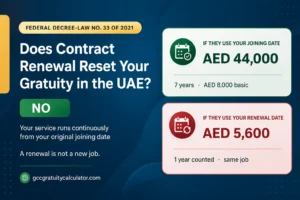
Contract Renewal Gratuity UAE: Does Your Service Reset?
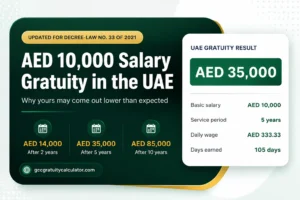
AED 10000 Salary Gratuity in UAE (2026): Why Yours Comes Out Lower Than Expected
Calculate Your Gratuity Before You Resign
Knowing your number before the conversation with HR changes how that conversation goes. It takes about a minute.
Free, no sign-up, and your figures are never stored.
Written and maintained by Farhan · Last updated August 2026
Checked against UAE Federal Decree-Law No. 33 of 2021, Cabinet Resolution No. 96 of 2023, and the UAE Government Portal.
About the author
Farhan built this calculator after seeing how often UAE employees walk into their final settlement meeting without knowing what they are owed. Every rule on this page is checked against the current UAE Labour Law and reviewed whenever the regulations change.
Disclaimer: This calculator provides an estimate for planning purposes and is not legal advice. For a binding figure, contact MOHRE or a UAE-licensed legal professional.