
SAR 6000 Salary Gratuity in Saudi Arabia (2026): What Changing Employer Costs You
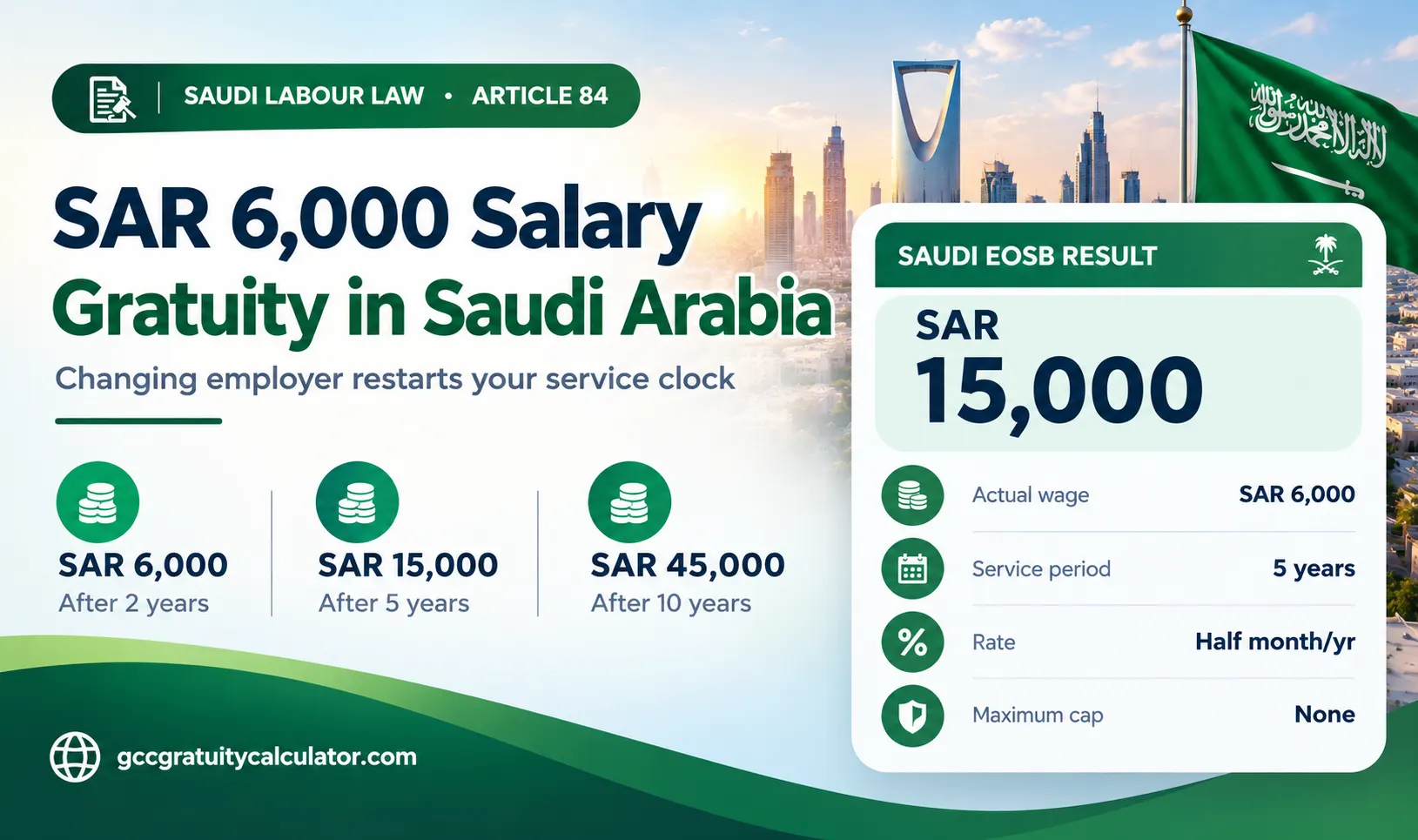
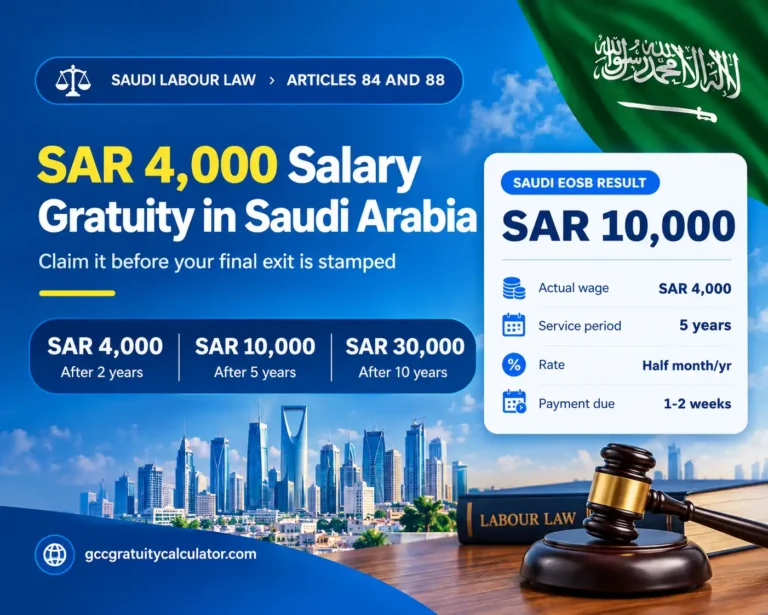
Your SAR 6000 salary gratuity is SAR 15,000 after five years and SAR 45,000 after ten.
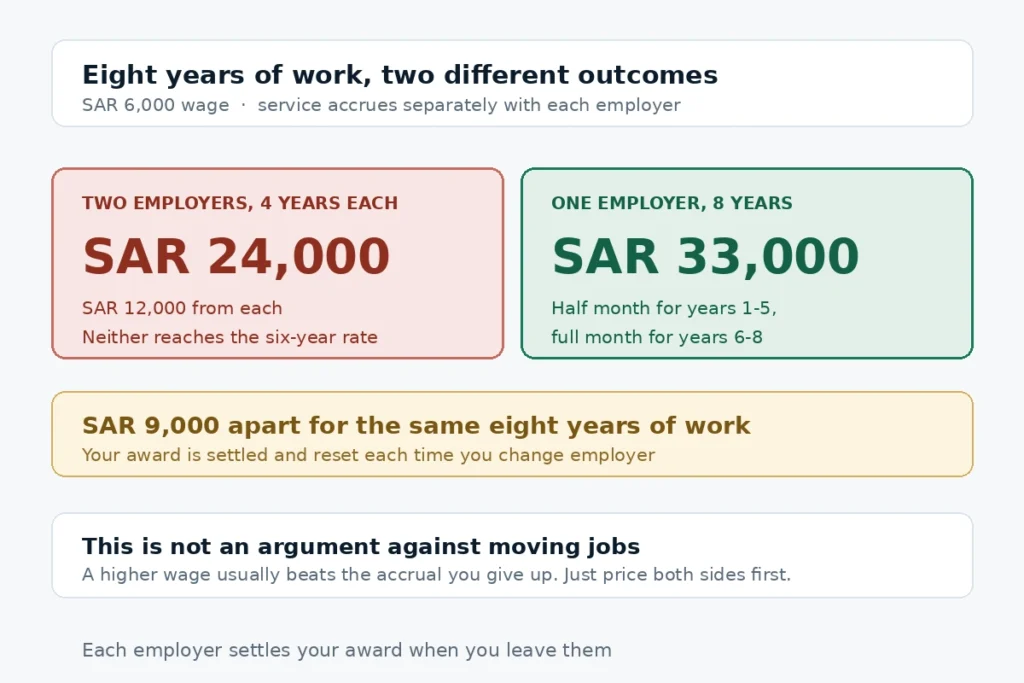
Those two numbers hide something worth knowing before your next move. Eight years with one employer pays SAR 33,000. The same eight years split across two employers pays SAR 24,000.
Same work, same wage, same length of service. SAR 9,000 less, purely because your service clock restarted.
Quick Answer
Half a month’s wage: SAR 6,000 ÷ 2 = SAR 3,000
| Years of service | Full award |
|---|---|
| 1 year | SAR 3,000 |
| 2 years | SAR 6,000 |
| 3 years | SAR 9,000 |
| 4 years | SAR 12,000 |
| 5 years | SAR 15,000 |
| 6 years | SAR 21,000 |
| 7 years | SAR 27,000 |
| 8 years | SAR 33,000 |
| 10 years | SAR 45,000 |
| 15 years | SAR 75,000 |
| 20 years | SAR 105,000 |
Each of your first five years earns half a month’s wage. From year six, each year earns a full month.
There is no maximum cap in Saudi Arabia.
Why Changing Employer Resets Everything
Your end-of-service award accrues with one employer. When you leave, that period is settled and closed. Your new employer starts you at year one.
That matters because of how the Article 84 rate works. The first five years accrue at half a month per year. Only from year six does it become a full month.
If you never stay past five years with a single employer, you never reach the higher rate at all.
The comparison
| Route | Award |
|---|---|
| Two employers, four years each | SAR 24,000 |
| One employer, eight years | SAR 33,000 |
The split route pays SAR 12,000 from each employer — four years at half a month, twice. Neither period ever crosses into the six-year band.
The single-employer route earns half a month for years one to five, then a full month for years six, seven and eight.
This Is Not an Argument Against Moving Jobs
It would be a poor conclusion to draw from the numbers above.
On SAR 6,000, staying an extra three years past the five-year mark earns you SAR 18,000 in additional award. A move that raises your wage by SAR 1,500 a month earns you SAR 54,000 over the same three years — and permanently lifts the base your future award is calculated on.
A better salary usually beats the accrual you give up. The point isn’t to stay put. It’s to know what you’re trading so the comparison is honest.
When staying is worth it
- You’re at four and a half years. Crossing five unlocks the higher rate for everything after it
- The new offer isn’t much higher. No raise to offset the reset
- You’re close to a threshold on a fixed-term contract. More on that below
When moving is worth it
- The offer is meaningfully higher. The wage increase compounds; the award reset is a one-time cost
- You’re early in your service. At two years there’s little accrued to lose
- Your current employer is on a fixed-term contract and you’d be resigning. The Article 85 reduction may already be cutting what you’d walk away with
Sponsorship Transfer Does Not Change This
Saudi Arabia’s labour reforms made it considerably easier to move between employers without the previous consent requirements.
What those reforms did not do is make your service continuous across employers. A transfer is still a new employment relationship with a new employer. Your previous employer settles your award for the period you worked with them, and your service starts again.
Ask for that settlement when you transfer, not later. Once you’ve moved on, chasing a previous employer for an award they should have paid at the time becomes considerably harder.
Your Allowances Count Towards the Award
Saudi EOSB runs on your wage as defined in Article 2 of the Labour Law — basic salary plus due increments. Fixed housing and transport allowances form part of that base.
This is the opposite of the UAE and Qatar, where gratuity is calculated on basic salary alone.
On a package of SAR 6,000 basic plus SAR 1,500 housing and SAR 600 transport, your wage is SAR 8,100:
| Basis used | 5 years | 10 years |
|---|---|---|
| Basic only (SAR 6,000) | SAR 15,000 | SAR 45,000 |
| Wage (SAR 8,100) | SAR 20,250 | SAR 60,750 |
SAR 15,750 of difference at ten years.
Article 86 permits an employer and employee to agree in writing that variable pay — commission, sales percentages and similar — is excluded from the award base. It doesn’t extend to a fixed housing allowance.
Ask HR which wage figure they used. If the answer is your basic salary alone, ask which provision supports leaving out your housing allowance.
Part Years Are Paid in Proportion
Article 84 entitles you to the award for fractions of a year proportionate to your period of service.
| Service | Full award |
|---|---|
| 1 year 6 months | SAR 4,500 |
| 2 years 3 months | SAR 6,750 |
| 3 years 6 months | SAR 10,500 |
| 4 years 8 months | SAR 14,000 |
| 5 years 6 months | SAR 18,000 |
| 7 years 4 months | SAR 29,000 |
Probation counts towards your service period. Training and apprenticeship periods do not.
If You Resign, Contract Type Decides
On a fixed-term contract, Article 85 reduces the award for resignation: nothing under two years, one third between two and five, two thirds between five and ten, and the full award at ten or more.
Since 19 February 2025, that reduction applies to fixed-term contracts only. Where an employee on an indefinite contract ends the relationship on notice, the full award is payable.
On SAR 6,000 with five years of service:
| Situation | Award |
|---|---|
| Terminated by employer | SAR 15,000 |
| Contract expired | SAR 15,000 |
| Resigned, indefinite contract | SAR 15,000 |
| Resigned, fixed-term contract | SAR 10,000 |
Check your Qiwa contract record before assuming which applies to you.
When the Reduction Never Applies
Article 87 overrides Article 85 entirely in three situations:
- Leaving due to force majeure — circumstances beyond your control
- A female employee resigning within six months of her marriage
- A female employee resigning within three months of giving birth
Article 81 works similarly. It allows you to leave immediately, without notice, and keep all your statutory rights including the full award, where the employer failed to meet essential obligations towards you.
When You Should Be Paid
Under Article 88, payment is due within one week where the employer ended the contract, and within two weeks where you did.
Your employer may deduct legitimate work-related debt before paying the balance, but you’re entitled to see each deduction itemised.
Settle before your final exit is processed. Recovering an unpaid award from outside the Kingdom is considerably harder than resolving it while you’re still there.
If your employer won’t move, file through the MHRSD friendly settlement process, which precedes the Labour Court. Bring your contract, Qiwa record, Iqama, payslips and bank statements showing salary transfers.
Run Both Scenarios
Enter your wage and dates in the Saudi Arabia Gratuity Calculator for your current employer. Then run the figure you’d have at your next anniversary, and compare that against the raise on offer elsewhere.
Comparing two specific numbers is far more useful than a general rule about staying or moving.
[Calculate My EOSB]
Frequently Asked Questions
How much gratuity on SAR 6,000 after 5 years?
SAR 15,000 if SAR 6,000 is your full wage. On SAR 6,000 basic plus SAR 2,100 in fixed allowances, it’s SAR 20,250.
How much after 2 years?
SAR 6,000.
How much after 10 years?
SAR 45,000.
Does my service transfer when I change employer?
No. Each employer settles your award for the period you worked with them, and your service starts again from year one.
Did the sponsorship transfer reforms change that?
No. Moving between employers is easier than it was, but your service is still not continuous across them.
Should I stay to reach five years?
It depends on the offer. Crossing five years unlocks the higher accrual rate, but a meaningfully higher wage usually beats it. Run both numbers before deciding.
Do my allowances count towards the award?
Yes. Saudi EOSB is calculated on your wage, which includes fixed housing and transport allowances.
Does resigning reduce it?
On a fixed-term contract, yes. Since February 2025 the reduction no longer applies to indefinite contracts.
Is there a maximum award?
No. Saudi Arabia sets no cap.
Does probation count towards my service? Yes. Training and apprenticeship periods do not.
How long does my employer have to pay?
One week if they ended the contract, two weeks if you did.
Last updated: September 2026 Based on: Saudi Labour Law (Royal Decree M/51), Articles 2, 81, 84, 85, 86, 87 and 88 · Royal Decree M/44 of 2024
Written by Farhan — About
Working on a different wage?
See our breakdowns for SAR 5,000, SAR 8,000 and SAR 10,000, SAR 25,000.

One Comment