
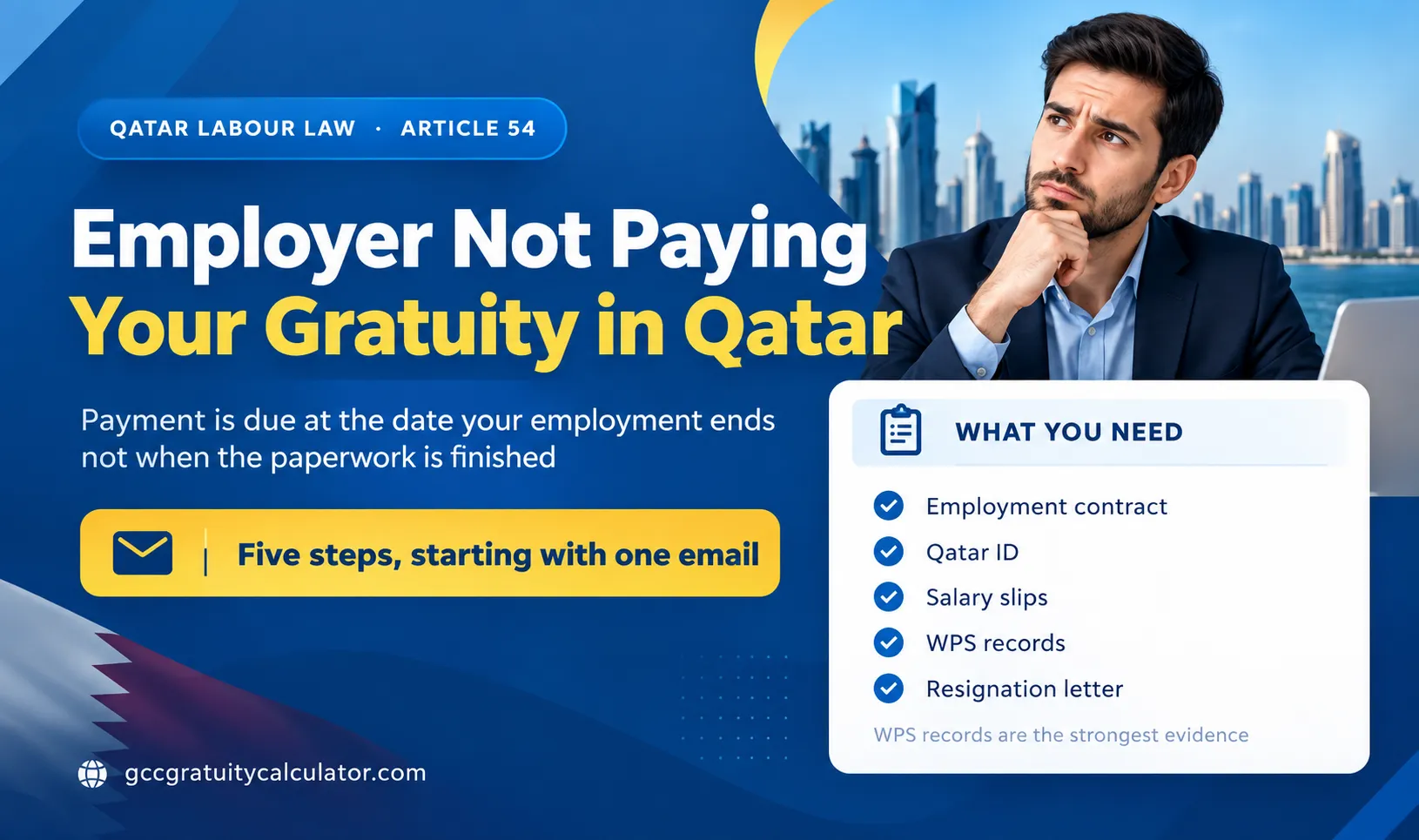
Employer Not Paying Gratuity Qatar: What to Do (2026)
You finished your notice, your last working day has passed, and the gratuity hasn’t arrived. HR says it’s being processed. Then the week goes by, and the next one.
If that’s where you are, the first thing worth knowing is that the delay itself is not normal. Qatar Labour Law sets a specific point at which your gratuity becomes due, and “after the paperwork is finished” is not it.
This guide covers what the law actually requires, what evidence you need, and the five steps that recover most unpaid settlements.
When Your Gratuity Legally Becomes Due
Article 54 of Qatar Labour Law No. 14 of 2004 requires the employer to pay the end-of-service gratuity, together with any other amounts owed to you, at the date the employment relationship ends.
Not two weeks later. Not after your visa is cancelled. Not once the finance department completes its next payment run.
That matters because it gives you a clear position to state in writing, and a date to point to. “It’s still being processed” is not a legal answer to an obligation that fell due on your last working day.
First, Check the Figure Is Actually Right
Before you treat this as a refusal to pay, make sure you and your employer are working from the same number. A surprising share of these disputes turn out to be a calculation disagreement rather than a refusal.
The Qatar calculation is:
Gratuity = (Basic salary ÷ 30) × 21 × Years of service
Three weeks of basic wage for each completed year, with part years paid in proportion, and no maximum cap. The rate does not increase after five or ten years — if you’ve seen a higher figure somewhere, it may be from a calculator still using the repealed escalating bands, which our QAR 5,000 breakdown explains.
Work out your own figure in the Qatar Gratuity Calculator before you send anything. Walking into this with a specific number changes the conversation entirely.
The Five Steps
Work through these in order. Most disputes end at the first one.
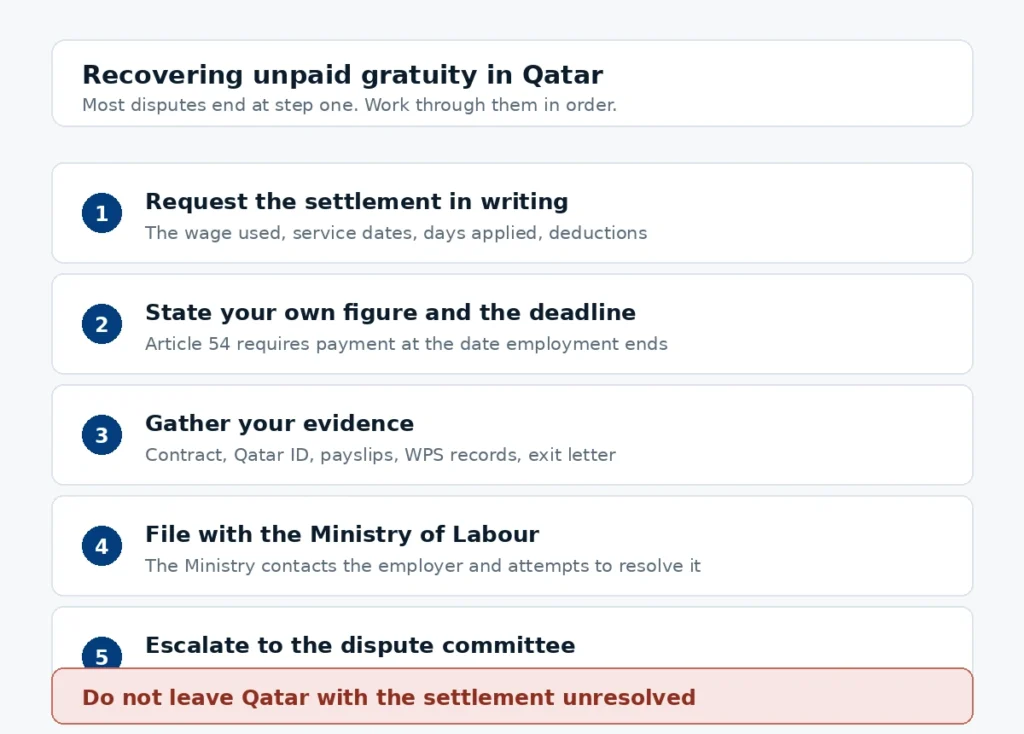
Step one: request the settlement in writing
Email HR and ask for an itemised final settlement statement showing four things:
- The basic salary used in the calculation
- Your service start and end dates
- The number of days applied per year
- Every deduction, listed separately
This single request resolves more disputes than anything else on this page. Once someone has to write the calculation down and attach their name to it, errors tend to surface on their own — and a company that was simply slow often becomes prompt.
Keep it short and neutral. You’re asking for a document, not opening a fight.
Step two: state your own figure and the deadline
If the statement doesn’t arrive, or the figure is wrong, reply with your own calculation and how you arrived at it.
Cite Article 54 and note that payment was due at the date the employment relationship ended. Give a specific date by which you expect the matter resolved.
Keep everything in the same email thread. A continuous written record where you asked reasonably and they didn’t respond is worth a great deal at the next stage.
Step three: gather your evidence
Collect these before you file anything:
- Employment contract and all renewals
- Qatar ID
- Salary slips
- Wage Protection System records or bank statements showing salary transfers
- Resignation or termination letter
- Any written correspondence where payment was refused or delayed
WPS records are the strongest evidence you have. They establish exactly what you were paid and for how long, and they’re independent of anything your employer produces. If there’s a dispute about your basic salary or your service dates, this is what settles it.
Step four: file a complaint with the Ministry of Labour
Complaints can be submitted through the Ministry of Labour’s official channels. The Ministry reviews the case, contacts the employer and attempts to resolve the dispute between you.
This stage works more often than people expect. A company that has been ignoring your emails responds differently when the Ministry contacts them directly.
Bring the documents from step three. A file with a contract, WPS records and a written objection is in a considerably stronger position than a verbal account.
Step five: escalate to the Labour Dispute Resolution Committee
Where the Ministry stage doesn’t settle it, the matter can be referred onward for formal determination.
By this point your documentation is doing most of the work. Employees who kept records throughout rarely need to argue the facts — only the amount.
Do Not Leave Qatar With This Unresolved
This is the single most important practical point on the page.
Once you’ve left the country, pursuing an unpaid settlement becomes considerably harder. You can’t attend meetings, you can’t visit the Ministry, and the practical leverage of being present disappears.
Employers who are genuinely stalling often rely on this. The pressure of a departure date is what pushes people into accepting less or giving up altogether.
If your travel date is approaching and the settlement isn’t resolved, file the complaint before you go. A week’s delay to your plans is a smaller cost than an unpaid settlement you’ll never recover.
If Your Visa Is Being Used as Leverage
Some employers link the gratuity to visa cancellation, either explicitly or by simply doing neither until you agree to something.
These are two separate obligations under two different articles. Your gratuity falls due under Article 54 at the date employment ends. Residency cancellation for non-Qatari employees must be completed within two weeks under Article 57. Neither is conditional on the other.
We’ve covered this in full in Can Your Employer Hold Your Gratuity Until Your Visa Is Cancelled?
Never Sign the Release Before You’re Paid
A release document confirms you’ve received everything you’re owed and have no further claim.
Signing it before the money arrives removes almost all of your position. Whatever was promised verbally becomes very difficult to pursue afterwards.
The correct order is:
- Receive the itemised statement
- Confirm the figure makes sense
- Receive the payment
- Then sign the release
If you’re being asked to reverse steps three and four, that’s the moment to slow down and put the request in writing.
Can They Refuse to Pay at All?
Only in the circumstances set out in Article 61, which covers specific serious misconduct — submitting forged documents, disclosing confidential information, causing serious financial loss to the employer, assault at the workplace, prolonged unexplained absence, or conviction for an offence involving honour or honesty.
These are defined grounds, not a general discretion. An employer who is unhappy that you resigned, or who disputes your performance, has no basis to withhold gratuity.
Gratuity is a statutory entitlement. It cannot be signed away by contract, and it cannot be withheld as a bargaining position during your exit.
Two Things That Might Explain a Lower Figure
If the amount arrived but looks short, these are the two most common reasons — and both are worth checking before you escalate.
They used your total package instead of your basic salary. Qatar gratuity runs on basic salary alone. Housing, transport, overtime and commission are all excluded. On a QAR 10,000 package with QAR 6,000 basic, ten years pays QAR 42,000 rather than QAR 70,000. Our QAR 10,000 breakdown covers this in detail.
They counted from your latest contract renewal. Renewals don’t reset your service. An employee on their third two-year contract has six years, not two. Ask which start date they used.
Frequently Asked Questions
When is gratuity legally due in Qatar?
At the date the employment relationship ends, under Article 54. Payment is not conditional on visa cancellation or on completing exit formalities.
How do I file a labour complaint in Qatar?
Through the Ministry of Labour’s official channels. The Ministry reviews the case, contacts your employer and attempts to resolve it before the matter escalates further.
What documents do I need?
Your employment contract and renewals, Qatar ID, salary slips, WPS records or bank statements showing salary transfers, and your resignation or termination letter.
Can my employer refuse to pay my gratuity?
Only in the specific misconduct circumstances defined in Article 61. Outside those, gratuity is a statutory entitlement that cannot be withheld.
Can they hold it until my visa is cancelled?
No. Those are separate obligations under Articles 54 and 57. Neither is conditional on the other.
Should I sign the release to speed things up?
No. Receive the itemised statement, confirm the figure, receive the payment, and sign last.
What if I’ve already left Qatar?
It becomes considerably harder but not automatically hopeless. Gather everything you have and contact the Ministry of Labour. The practical difficulty is why filing before departure matters so much.
My employer says there’s no money. Does that change anything?
It doesn’t change the obligation. A company’s financial position is not a lawful basis for withholding a statutory entitlement, and the Ministry process exists for exactly this situation.
How long does the complaint process take?
It varies with the case and how complete your documentation is. Employees who file with a contract, WPS records and a written objection generally move faster than those relying on a verbal account.
Is there a time limit on claiming?
Do not treat this as open-ended. Act promptly, and act before you leave the country.
Last updated: September 2026 Based on: Qatar Labour Law No. 14 of 2004, Articles 54, 57 and 61
Written by Farhan — About
Work out what you’re owed first: use the Qatar Gratuity Calculator for a year-by-year breakdown you can attach to your written request.

One Comment